The best digital microscopes for students depend on what they need to see: the TOMLOV DM301 Max is my best overall pick for screen-based exploration, while the AmScope B120 Series suits students who need a more traditional compound microscope with a camera. For hands-on classroom work, the 4.3-inch display models offer a simple way to view specimens together, and the BMDSAE handheld model favors portability and ease of use. The main tradeoffs are screen convenience versus optical viewing, portability versus stability, and general-purpose use versus specialized features. Read on for how all nine options compare and which type of student each one fits best.

Get school and study supplies delivered free — and shop member deals
- Fast, free delivery on millions of items
- Access to Prime Big Deal Days deals on October 6–7
- Prime Video, Amazon Music and more included
Key Takeaways
- The lineup splits into distinct use cases: compound microscopes such as the AmScope B120 and Woehrsh are aimed at prepared slides, while the TOMLOV DM4W Max and Elikliv EDM4 focus on coins and other objects viewed from above.
- A larger screen changes group learning: the TOMLOV DM4W Max and DM301 Pro have 7-inch displays, which make shared viewing easier than the 4.3-inch screens on the OOZSTAR and Elikliv models.
- Magnification claims do not tell the whole story: students should match the microscope’s optics and working distance to slides, surfaces, or handheld objects rather than choosing by the highest stated number.
- Camera and display convenience come with tradeoffs: built-in screens can simplify observation, while USB-camera setups such as the Woehrsh and AmScope require a compatible computer and may suit desk-based work better.
- The most specialized models are not automatic classroom upgrades: the DM4W Max adds a weighing scale for coin work, while the BMDSAE favors portability; each is less versatile than a stable, general-purpose setup.
| Microscope 40X-2500X Magnification with 4.3-inch Display, Wide-Angle 10X and 25X Eyepieces, Built-in 5-Megapixel Camera for School Labs (Black) | 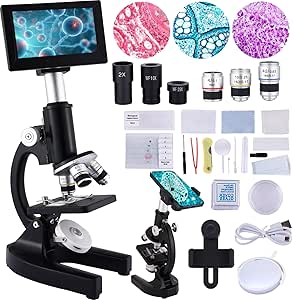 | Best for School Lab Versatility | Magnification range: 40x–2500x | Display: 4.3-inch HD display | Camera: 5 MP | VIEW LATEST PRICE | See Our Full Breakdown |
| TOMLOV DM301 Max Digital Microscope |  | Best for Shared Student Viewing | Display: 7-inch IPS screen | Magnification: Up to 1200x | Image capture: 8 MP | VIEW LATEST PRICE | See Our Full Breakdown |
| Woehrsh Trinocular Compound Microscope, 40X–5000X, with Mechanical Stage and USB Camera |  | Best for Hands-On Compound Microscopy | Microscope type: Compound trinocular | Magnification: 40x–5000x | Objective lens: 195 achromatic | VIEW LATEST PRICE | See Our Full Breakdown |
| OOZSTAR Digital Microscope with 4.3-Inch Display and 5 MP Camera |  | Best for Beginners with Starter Materials | Maximum magnification: 2500x listed | Listed magnification settings: 100x, 250x, 1000x, 200x, 500x, and 2000x | Display: 4.3-inch | VIEW LATEST PRICE | See Our Full Breakdown |
| TOMLOV DM4W Max Digital Coin Microscope with Weighing Scale, 7-Inch Screen |  | Best for Coin and Specimen Projects | Screen: 7 inches; 800 × 480 resolution | Video resolution: 2K | Photo resolution: Up to 5440 × 3060 (16 MP) | VIEW LATEST PRICE | See Our Full Breakdown |
| AmScope B120 Series LED Binocular Compound Microscope with 5MP Camera |  | Best for Structured Student Lab Work | Model: B120C-E5 | Magnification: 40X–2500X | Camera: 5MP USB microscope camera | VIEW LATEST PRICE | See Our Full Breakdown |
| TOMLOV DM301 Pro Digital Microscope with 7-Inch Screen |  | Best for Classroom Sharing | Model: DM301 Pro | Display: 7-inch IPS screen | Magnification: Up to 1200X | VIEW LATEST PRICE | See Our Full Breakdown |
| BMDSAE 1000X Handheld Digital Microscope for Kids with 2-Inch IPS Screen |  | Best for Young Explorers | Model: 382 | Magnification: Up to 1000X | Screen: 2-inch IPS | VIEW LATEST PRICE | See Our Full Breakdown |
| Elikliv EDM4 Digital Coin Microscope with 4.3-Inch Display |  | Best for Stable Object Inspection | Model: EDM4 | Display: 4.3-inch LCD | Resolution: 720p HD | VIEW LATEST PRICE | See Our Full Breakdown |
| digital microscopes for student | Lighting | Camera | Magnification | Display |
|---|---|---|---|---|
| Microscope 40X-2500X Magnifica | — | 5 MP | — | 4.3-inch HD display |
| TOMLOV DM301 Max Digital Micro | Adjustable top and bottom LED lights | — | Up to 1200x | 7-inch IPS screen |
| Woehrsh Trinocular Compound Mi | LED | USB electronic eyepiece; resolution not specified | 40x–5000x | — |
| OOZSTAR Digital Microscope wit | LED | 5 MP | — | 4.3-inch |
| TOMLOV DM4W Max Digital Coin M | LED | — | — | — |
| AmScope B120 Series LED Binocu | — | 5MP USB microscope camera | 40X–2500X | — |
| TOMLOV DM301 Pro Digital Micro | Adjustable dual LED lighting | 8MP photos; 1080p videos | Up to 1200X | 7-inch IPS screen |
| BMDSAE 1000X Handheld Digital | 8 adjustable LEDs with 3 brightness modes | 2MP | Up to 1000X | — |
| Elikliv EDM4 Digital Coin Micr | 8 adjustable LED lights | — | Up to 1000x; actual magnification varies | 4.3-inch LCD |
More Details on Our Top Picks
Microscope 40X-2500X Magnification with 4.3-inch Display, Wide-Angle 10X and 25X Eyepieces, Built-in 5-Megapixel Camera for School Labs (Black)
For students who need both familiar microscope controls and a built-in screen, this OOZSTAR pairs achromatic 4x, 10x, and 40x objectives with a 4.3-inch display and 5 MP camera. The screen allows a student or teacher to view a specimen without staying hunched over an eyepiece, while the included lab accessories make it easier to start basic activities. Its stated 40x–2500x range is broader than the TOMLOV DM301 Max’s up-to-1200x range, though magnification alone does not tell you how much useful detail the optics will resolve. The tradeoff is a smaller display than the TOMLOV’s 7-inch screen, and the battery runtime is not specified. I’d choose this for flexible classroom or home use, but not for students who need a larger shared viewing area or clearly documented battery life.
Pros:- 4.3-inch display supports viewing without constant eyepiece posture.
- 5 MP camera can capture specimen images.
- Achromatic 4x, 10x, and 40x objective lenses offer conventional compound-microscope options.
- USB or battery power and an included accessory kit support different study settings.
Cons:- The 4.3-inch display is smaller than the TOMLOV DM301 Max’s 7-inch screen.
- Battery runtime is not specified, which makes unplugged study sessions harder to plan.
- The stated maximum magnification does not by itself establish the amount of useful optical detail.
Best for: Students and families who want a screen-equipped microscope with conventional objective lenses, a camera, and included lab accessories for varied home or classroom activities.
Not ideal for: Students who need a large display for group viewing, or buyers who require a stated battery runtime before taking the microscope away from USB power.
- Magnification range:40x–2500x
- Display:4.3-inch HD display
- Camera:5 MP
- Objective lenses:Achromatic 4x, 10x, and 40x
- Eyepieces:Wide-angle 10x and 25x
- Illumination:LED
- Power:USB data cable or batteries
- Weight:1.66 kg
Our verdict“Choose this OOZSTAR for a flexible student lab setup with a built-in camera and screen, but pick the TOMLOV DM301 Max if a larger display matters more.”
TOMLOV DM301 Max Digital Microscope
The DM301 Max earns its place through a 7-inch IPS screen and a metal X-Y stage: students can watch an image together, then move a specimen in controlled increments instead of nudging it by hand. Adjustable top and bottom LEDs suit different specimen types, and 8 MP still images plus 1080P video give students material to revisit for assignments. Compared with the OOZSTAR 4.3-inch model, the TOMLOV provides a larger viewing surface and a stated stage scale; its listed maximum magnification is lower, at 1200x. That makes this a stronger fit for guided observation and documenting classwork than for buyers chasing the biggest number on a specification sheet. The costs in convenience are a battery life of up to three hours and reliance on a compatible phone or external display for some sharing features.
Pros:- 7-inch IPS screen is well suited to shared viewing and longer observation sessions.
- Metal X-Y stage with 1.0 mm scale divisions supports controlled specimen movement.
- 8 MP images and 1080P video can document observations.
- Adjustable top and bottom LED lighting and included slides support varied activities.
Cons:- Battery life is listed as up to three hours.
- Some viewing and sharing features require a compatible phone or external display.
- Maximum stated magnification is 1200x, below the OOZSTAR models’ listed 2500x.
Best for: Teachers, small study groups, and students who want to view specimens on a large screen, capture classwork, and make measured stage adjustments.
Not ideal for: Students who need long battery-powered sessions or want a microscope that provides every sharing feature without a compatible phone or external display.
- Display:7-inch IPS screen
- Magnification:Up to 1200x
- Image capture:8 MP
- Video:1080P
- Stage:Metal X-Y stage with 1.0 mm scale divisions
- Lighting:Adjustable top and bottom LED lights
- Connectivity:Wi-Fi app control, USB, and HD output
- Battery life:Up to 3 hours
- Included slides:5 prepared slides and 5 blank slides
Our verdict“Pick the DM301 Max for group-friendly screen viewing, specimen positioning, and documentation, provided its limited battery life suits your study setup.”
Woehrsh Trinocular Compound Microscope, 40X–5000X, with Mechanical Stage and USB Camera
Students learning traditional compound-microscope technique may get more from this Woehrsh than from a screen-first device: it has a dual mechanical stage, coaxial coarse and fine focus, and a swiveling trinocular head. Those controls support deliberate specimen positioning and focusing, while the USB electronic eyepiece offers a route to computer viewing. Its stated 40x–5000x range exceeds the digital OOZSTAR’s listed range, but the camera resolution and compatibility are not specified, so I wouldn’t choose it primarily for polished digital records. Unlike the TOMLOV DM301 Max, it has no built-in display listed; students will need to use its eyepieces or sort out the USB camera setup. The included slides and accessories broaden the teaching use, but the longer kit list also means more parts to organize.
Pros:- Dual mechanical stage allows more controlled specimen movement than a hand-positioned sample.
- Coaxial coarse and fine focus supports gradual focusing adjustments.
- Trinocular head swivels 306 degrees and includes a USB electronic eyepiece.
- Slides, coverslips, specimens, and other lab accessories are included.
Cons:- USB camera resolution and compatibility are not specified.
- No built-in display is listed, unlike the TOMLOV DM301 Max and OOZSTAR digital models.
- The many included accessories require more setup and organization.
Best for: Students studying cell biology or microscopy skills who want a conventional compound instrument with mechanical specimen control and the option of USB imaging.
Not ideal for: Beginners who want an immediately usable built-in screen, or students who need confirmed camera resolution and computer compatibility before purchase.
- Microscope type:Compound trinocular
- Magnification:40x–5000x
- Objective lens:195 achromatic
- Eyepieces:Two WF10x and two WF25x
- Stage:Dual mechanical, double-layer stage
- Focus:Dual coaxial coarse and fine
- Lighting:LED
- Viewing head:306-degree swivel
- Camera:USB electronic eyepiece; resolution not specified
Our verdict“Choose the Woehrsh for students who want hands-on compound-microscope controls, not for those prioritizing a ready-to-use digital screen or specified camera performance.”
OOZSTAR Digital Microscope with 4.3-Inch Display and 5 MP Camera
This white OOZSTAR is the more clearly starter-oriented of the two OOZSTAR listings: it includes five specimens, five slides, and 100 coverslips, giving new students supplies to practice preparing and viewing samples. Its 4.3-inch display and 5 MP camera keep the core digital workflow simple, while data-cable or battery power offers some flexibility. Compared with the black OOZSTAR 40X-2500X model, this one lists WF10x and WF16x eyepieces rather than 10x and 25x, and its magnification details are inconsistent: it claims up to 2500x but also lists several settings in a confusing order. That makes it harder to know what each setting delivers before buying. The accessory bundle favors hands-on exploration, but students seeking dependable, clearly documented magnification should look at the TOMLOV DM301 Max instead.
Pros:- Includes five specimens, five slides, and 100 coverslips for starter activities.
- Built-in 4.3-inch display and 5 MP camera support screen viewing and image capture.
- Achromatic 4x, 10x, and 40x objective lenses are listed.
- Can use a data cable or batteries for power.
Cons:- The stated 2500x maximum and listed magnification settings are inconsistent.
- Battery type and runtime are not specified.
- Its 4.3-inch screen is smaller than the TOMLOV DM301 Max’s 7-inch display.
Best for: Younger students and families beginning home microscope activities who want a screen, basic image capture, and a substantial supply of slides and coverslips.
Not ideal for: Students who need clearly documented magnification settings, known battery runtime, or a larger display for group observation.
- Maximum magnification:2500x listed
- Listed magnification settings:100x, 250x, 1000x, 200x, 500x, and 2000x
- Display:4.3-inch
- Camera:5 MP
- Eyepieces:WF10x and WF16x wide-angle
- Objective lenses:Achromatic 4x, 10x, and 40x
- Lighting:LED
- Power:Data cable or batteries
- Included supplies:5 specimens, 5 slides, and 100 coverslips
Our verdict“This OOZSTAR suits beginners who value a ready-made supply of practice materials, but students who need clearly stated magnification should choose a better-documented option.”
TOMLOV DM4W Max Digital Coin Microscope with Weighing Scale, 7-Inch Screen
The DM4W Max is a specialist rather than a general classroom microscope: its built-in scale and close-up camera are aimed at inspecting and weighing coins, jewelry, and small valuables. For students working on a collecting, materials, or measurement project, one station can show surface details and record weight in grams, ounces, carats, or troy ounces. Its 7-inch screen is larger than the OOZSTAR displays, and the 2K video and up-to-16 MP photos add useful documentation options. The compromise is fit: full-view coin size is limited to 32 mm, larger coins may need repositioning, and the scale’s stated ±0.5 g accuracy may be too coarse for fine measurements. I’d choose the DM301 Max for broader specimen-based lessons; this model makes more sense when weighing is part of the assignment.
Pros:- Combines magnified inspection and a built-in weighing scale.
- Scale offers g, oz, ct, and ozt units.
- Captures 2K video and photos up to 5440 × 3060.
- 7-inch screen and USB output support viewing and computer connection.
Cons:- Coins larger than 32 mm may need repositioning for detailed inspection.
- Scale accuracy is listed as ±0.5 g, limiting fine-weight work.
- Its coin-focused design is less suited to standard prepared-slide lessons than the Woehrsh compound microscope.
Best for: Students doing coin-collecting, materials, or small-object projects that benefit from viewing surface details and recording approximate weight in one setup.
Not ideal for: Students seeking a general-purpose compound microscope for prepared slides, or anyone needing precise weighing or full-frame viewing of coins larger than 32 mm.
- Screen:7 inches; 800 × 480 resolution
- Video resolution:2K
- Photo resolution:Up to 5440 × 3060 (16 MP)
- Weighing resolution:0.1 g
- Weighing accuracy:±0.5 g
- Weighing units:g, oz, ct, and ozt
- Full-view coin size:Up to 32 mm
- Connectivity:USB output; Win/Mac compatible
- Lighting:LED
Our verdict“Choose the DM4W Max for student projects that combine close-up coin inspection with approximate weighing, not as a replacement for a standard slide microscope.”
AmScope B120 Series LED Binocular Compound Microscope with 5MP Camera
The AmScope B120C-E5 is the strongest fit here for students learning traditional slide microscopy. Its binocular eyepieces and adjustable Siedentopf head support longer observation sessions, while the 5MP USB camera and analysis software let students save images for reports. Compared with the TOMLOV DM301 Pro, this is a more conventional compound microscope: it prioritizes eyepiece-based study and a broad stated magnification range over a built-in display and wireless sharing. That makes it better suited to guided biology work than casual viewing of larger objects. The tradeoff is a less self-contained setup; students need a computer for the camera, and the listing does not specify a screen or standalone capture controls. Its 40X–2500X range is broad on paper, but magnification alone does not guarantee useful detail at every setting.
Pros:- Binocular head supports viewing through eyepieces during extended study
- 5MP USB camera and included software support image capture and analysis
- Daylight-balanced LED illumination provides adjustable specimen lighting
- Stated 40X–2500X range covers a wide span of compound-microscope work
Cons:- Requires a separate computer for camera-based viewing and capture
- No built-in display or listed wireless viewing option
- The broad magnification range does not by itself indicate image detail at each setting
Best for: Students doing instructor-led biology labs who need binocular viewing and a USB camera for documenting slide observations.
Not ideal for: Students who want a portable, all-in-one screen or wireless group viewing; the camera depends on a computer, unlike the TOMLOV DM301 Pro.
- Model:B120C-E5
- Magnification:40X–2500X
- Camera:5MP USB microscope camera
- Illumination:Daylight-balanced LED
- Head:Adjustable Siedentopf binocular
- Software:Image capture and analysis software included
- Warranty:5 years
Our verdict“Choose the AmScope for structured slide-based coursework and computer-assisted documentation, not for a portable screen-first microscope.”
TOMLOV DM301 Pro Digital Microscope with 7-Inch Screen
The TOMLOV DM301 Pro makes group observation easier than the AmScope B120C-E5 because students can view specimens on its 7-inch IPS screen rather than taking turns at eyepieces. Its Wi-Fi app support and USB and HD outputs also give teachers several ways to share images or video on other displays. The kit includes prepared and blank slides, so a student can start exploring without sourcing basic materials. Three achromatic lenses and adjustable dual LEDs support slide viewing, while 8MP photos and 1080p video provide documentation options. The compromise is its up-to-three-hour battery life, which may call for charging during longer sessions. Unlike the AmScope, this model is designed around a digital screen rather than binocular viewing, so it is less suited to students specifically practicing conventional eyepiece microscopy.
Pros:- Large adjustable-angle 7-inch IPS display supports shared viewing
- Wi-Fi app support plus USB and HD output offer flexible sharing
- Includes prepared and blank slides, a microSD card, and a carrying case
- Captures 8MP photos and 1080p video
Cons:- Battery life is limited to up to three hours
- Screen-first viewing does not provide the binocular eyepiece experience of the AmScope B120C-E5
- The built-in display and accessory kit make it less compact than a handheld microscope
Best for: Students, families, or small teaching groups who want to view slides together on a built-in screen and share captures with a phone or external display.
Not ideal for: Students focused on learning binocular eyepiece technique or needing long sessions away from power; its battery is rated for up to three hours.
- Model:DM301 Pro
- Display:7-inch IPS screen
- Magnification:Up to 1200X
- Lenses:Three achromatic lenses
- Camera:8MP photos; 1080p videos
- Lighting:Adjustable dual LED lighting
- Connectivity:Wi-Fi app support; USB and HD output
- Battery life:Up to 3 hours
- Warranty:One year
Our verdict“Pick the DM301 Pro when shared screen viewing and ready-to-use slide accessories matter more than extended battery life or eyepiece practice.”
BMDSAE 1000X Handheld Digital Microscope for Kids with 2-Inch IPS Screen
For younger students, the BMDSAE 382 puts a screen and basic capture tools in a 200g handheld body with a lanyard. That makes it more approachable for looking at objects around the home or outdoors than the stand-based Elikliv EDM4, which is better suited to steady inspection on a work surface. The BMDSAE offers up to 1000X magnification, eight adjustable LEDs, and storage for photos or AVI video, so discoveries can be saved without a separate memory card. Its manual focus gives students a hands-on way to sharpen the view, but it may take practice, especially for younger children. The 2-inch screen is far smaller than the Elikliv’s 4.3-inch display, and the battery lasts up to two hours. It suits informal exploration better than detailed group demonstrations or long sessions.
Pros:- Lightweight 200g design and included lanyard suit handheld exploration
- Built-in 2MP camera captures photos and AVI videos
- Eight adjustable LEDs with three brightness modes help adapt illumination
- Internal storage supports more than 200 photos or video files
Cons:- Manual focus can be difficult for younger students to control
- Two-inch screen is much smaller than the Elikliv EDM4 display
- Battery is rated for up to two hours
Best for: Children over three and families seeking a lightweight, handheld microscope for short, supervised explorations and simple photo or video capture.
Not ideal for: Students who need a large viewing area, stable stand-based inspection, or long uninterrupted sessions; the screen is 2 inches and battery life is up to two hours.
- Model:382
- Magnification:Up to 1000X
- Screen:2-inch IPS
- Camera:2MP
- Lighting:8 adjustable LEDs with 3 brightness modes
- Battery:600mAh; up to 2 hours
- Storage:32M; supports 200+ photos or AVI videos
- Weight:200g
- Connectivity:USB-C
Our verdict“Choose the BMDSAE for short, portable discovery sessions with young students, but select a larger-screen stand model for careful shared inspection.”
Elikliv EDM4 Digital Coin Microscope with 4.3-Inch Display
The Elikliv EDM4 is a practical choice for students examining coins, jewelry, circuit boards, and other objects that sit on a base. Its 4.3-inch display and adjustable bracket make it easier to keep an object steady and view it comfortably than with the handheld BMDSAE 382. The eight adjustable LEDs help illuminate surfaces, and Windows and Mac compatibility lets students connect to a computer for viewing. Compared with the TOMLOV DM301 Pro, the EDM4 is a simpler setup: it has a smaller screen and no listed wireless app support, but its focus on stand-based close inspection fits projects involving surface details rather than group slide demonstrations. The memory card is sold separately, and the stated up-to-1000x figure varies with viewing distance and screen size, so buyers should not treat it as a guaranteed level of useful detail.
Pros:- 4.3-inch screen offers a larger viewing area than the BMDSAE 382
- Adjustable bracket and plastic base support steadier object inspection
- Eight adjustable LEDs help illuminate different surfaces
- Connects to Windows and Mac computers and runs on a rechargeable battery
Cons:- Memory card for saving photos and videos is not included
- Actual magnification varies with viewing distance and screen size
- No listed Wi-Fi app support, unlike the TOMLOV DM301 Pro
Best for: Students working on coins, electronics, jewelry, or other small solid objects who want a stable stand and a screen larger than a handheld unit provides.
Not ideal for: Students studying biological slides with compound-microscope techniques or anyone who expects wireless sharing and included storage; the memory card is not included.
- Model:EDM4
- Display:4.3-inch LCD
- Resolution:720p HD
- Magnification:Up to 1000x; actual magnification varies
- Lighting:8 adjustable LED lights
- Battery life:Up to 3 hours
- Compatibility:Windows and Mac
- Media capture:Photos and videos; memory card not included
- Warranty:1 year
Our verdict“Choose the EDM4 for steady inspection of small solid objects, but look elsewhere for slide-focused compound study or wireless classroom sharing.”

How We Picked
I ranked these microscopes by how well their design matches common student tasks: examining prepared slides, observing larger objects, sharing a live view, and recording images. I gave more weight to practical usability, stable positioning, display or camera workflow, and appropriate illumination than to headline magnification figures alone. Build and setup also matter for school use, where students may need to adjust focus, change specimens, and return the instrument to storage without a complicated routine.
The ranking favors versatile models that can serve a range of learning activities, then assigns specialized options to narrower roles. That is why a general-purpose digital microscope ranks ahead of coin-specific equipment for most students, while compound models remain strong choices for slide-based biology. I also account for tradeoffs: an integrated screen can make group viewing easier, but a USB camera may fit a computer-based lab better; a compact handheld microscope travels well, but it is harder to hold steady for detailed work.
Factors to Consider When Choosing Digital Microscopes For Students
Before choosing among these student microscopes, start with the work the student will actually do. A camera or large display cannot compensate for a microscope that is awkward for the specimens, room, or supervision available. These broader checks can help avoid buying around an impressive-sounding specification instead of a usable learning setup.
Match the Optical Design to the Specimen
A compound microscope is usually the better format for thin, light-transmitting samples on slides, such as prepared plant or animal tissue. A digital microscope that views objects from above is more suitable for coins, leaves, insects, and textured surfaces that do not fit on a slide. A high magnification claim does not make one design a substitute for the other: working distance, lighting, focus control, and specimen preparation all affect what a student can see. Before buying, list a few likely classroom activities and check whether they use slides or solid objects. If both are common, prioritize the format used most often and treat the other as a separate tool rather than expecting one instrument to do everything well.
Choose a Viewing Setup That Fits the Classroom
An integrated screen lets students see a live image without leaning into eyepieces and can help a teacher demonstrate a specimen to a small group. A USB camera can suit a workstation where images need to appear on a computer, but it adds another device and connection to set up. Screen size matters most when several students need to view at once; it matters less for a single student working close to the microscope. Check whether the product records still images or video, how files move to another device, and whether the connection works with the school’s computers. A camera is useful for documenting observations, but it should not outweigh basic focusing comfort and a stable stand.
Treat Magnification as One Part of Image Quality
Students often compare microscopes by their largest advertised magnification, but a bigger number does not guarantee more useful detail. Optical quality, illumination, focus precision, and the specimen itself set practical limits. For younger learners, a clear image at a manageable magnification can teach more than a dim, difficult-to-focus view at an extreme setting. Consider whether the included eyepieces or camera support useful viewing ranges, and check how easily a student can move from a broad view to a close one. For slide work, sample preparation and light control can make as much difference as the instrument’s stated magnification range.
Prioritize Stability and Handling for the Student’s Age
A microscope that is easy to carry may be less steady when a student adjusts focus or positions a specimen. Handheld models can encourage exploration around the home or outdoors, but maintaining a fixed distance and angle takes practice. Bench models tend to offer more stable positioning, though they need a dedicated table and careful storage. For younger students, look for controls they can operate without repeatedly bumping the specimen or losing focus. If the microscope will travel between school and home, consider the full setup—including stand, cables, and accessories—not only the instrument’s size.
Check the Whole Workflow, Not Just the Microscope
Digital observation often depends on details beyond the main unit: compatible cables, software, device ports, lighting, and a place to save files. A USB camera can be a poor fit if school computers restrict software installation or lack the required connection. A built-in screen reduces those dependencies, but families should still check how images are stored and transferred. For classroom use, consider whether several students can take turns efficiently and whether the teacher can display saved images later. Confirm what is included and what must be supplied separately before choosing a model for a lesson plan.
Pay for the Feature That Solves a Real Problem
A larger screen can be worth prioritizing when group viewing is routine, while a weighing scale is relevant mainly for coin or collecting activities. A more elaborate compound setup makes greater sense for sustained slide-based study than for occasional curiosity at home. Extra magnification or accessories add little if the student cannot focus confidently or the classroom has no time to manage setup. Think about how often the specialized feature will be used and whether it supports a specific assignment or learning goal. When use is uncertain, a straightforward, general-purpose design is often a more sensible starting point than a niche feature set.
Frequently Asked Questions
Should I choose a digital microscope with a built-in screen or a USB camera?
Choose a built-in screen if a student needs to start viewing quickly or several people will share the image without a computer. A USB-camera model may suit a dedicated lab workstation where students need to view, capture, or discuss images on a larger computer display. The computer route can bring extra setup, including checking ports and software access, which may be a problem on managed school devices. A built-in screen keeps the main viewing workflow contained, though you should check how images are saved or transferred. Let the classroom’s devices and lesson routine guide the decision rather than assuming one connection type is always better.
Can one microscope handle both prepared slides and coins or leaves?
Some digital microscopes can view a range of objects, but slide work and surface inspection place different demands on the instrument. Prepared slides usually call for a compound design that sends light through a thin sample, while coins and leaves are commonly viewed from above with reflected light. A general-purpose digital model may cover several everyday objects, but it may not provide the same slide-viewing experience as a dedicated compound microscope. If biology lessons regularly use prepared slides, give that task priority. If the student mostly examines solid objects, a top-down digital model will usually be the more convenient fit.
Is a handheld microscope a good choice for a young student?
A handheld model can be a practical entry point when portability and quick exploration matter more than a steady laboratory setup. Its screen helps the student see an image without needing to align an eye with an eyepiece. The tradeoff is that keeping the camera at a consistent distance and angle can take coordination, which may make detailed observations frustrating. For repeated slide work or activities that need stable focus, a stand-mounted microscope is generally easier to manage. A handheld unit makes the most sense when an adult can help with positioning or when the main goal is casual inspection of larger objects.
Do students need a microscope with very high magnification?
Most students should start by asking what the class will observe, not by chasing the largest number on a specification sheet. Useful magnification depends on optical clarity, lighting, focus control, and whether the sample is suited to the microscope’s design. A high setting can make the viewing area smaller and focusing more demanding, which may slow down beginners. Prepared slides and solid objects also call for different optical arrangements, so a large stated range cannot replace choosing the right microscope type. For schoolwork, easy focusing and a clear image at commonly used settings are often more helpful than an extreme maximum.
What should I check before using a digital microscope with a school computer?
Check the computer’s available ports, operating system, and rules for installing camera software before choosing a USB-connected model. Some school devices limit new software or external accessories, which can prevent a camera from working during class even when the microscope itself is suitable. Find out whether image capture uses a standard camera function or requires a dedicated application, and ask how files can be saved for assignments. If access to school devices is uncertain, a microscope with its own screen can avoid some of those dependencies. Families should also confirm whether the required cable or adapters are included.
Conclusion
For most students who want direct screen viewing and a flexible digital format, I recommend the TOMLOV DM301 Max as best overall. The best value direction is a straightforward 4.3-inch display model such as the OOZSTAR when a simple viewing setup matters more than a larger screen or specialized extras. For a best premium choice, the TOMLOV DM4W Max is the specific-use pick for coin study and weighing, not the default for every classroom. Beginners who prioritize easy handling may prefer the BMDSAE handheld microscope, while students focused on prepared slides should look to the AmScope B120 Series or Woehrsh compound model. Choose by specimen and classroom workflow first; that will narrow the field more reliably than magnification claims alone.
Halloween Picks
halloween
As an affiliate, we earn on qualifying purchases.