For students who need a flexible starter set, I’d put the DEXSUR 30-Piece Stainless Steel Dissection Kit at the top of this roundup, while the DR Instruments 24-Piece Biology Kit stands out for its case and the DR Instruments 7-Piece Budget Kit for students who need only core tools. The main tradeoff is straightforward: larger kits offer more tool variety, but can add pieces a beginner may not use; compact sets are easier to manage but may not match a class supply list. Intended use matters too, since biology labs and medical or veterinary anatomy courses can call for different tools. I compare all 14 options by their stated contents, organization, and student fit below. Continue reading for the full breakdown and guidance on choosing a kit for your coursework.

Prime made for students and young adults
- Fast, free delivery for dorm and study essentials
- Prime Video and Amazon Music included
- Member-only deals
Key Takeaways
- The DEXSUR 30-piece set is the roundup’s balanced pick: its mid-size tool count offers more range than a compact starter kit without the extensive inventory of the 38- and 46-piece options.
- Kit size does not automatically mean better fit: the 7-piece DR Instruments and DEXSUR sets may suit a class with a short required-tools list better than a larger collection.
- Storage is a meaningful point of difference: the DR Instruments 24-piece kit explicitly includes a case, which can help keep tools together between lab sessions.
- Course level changes the shortlist: medical and veterinary students may want to compare the Core Flex 38-piece, DR Instruments Gross Anatomy 21-piece, and BioPrecision 46-piece sets against their course requirements.
- Shared or classroom use favors quantity: Dunzoom’s two 32-piece sets provide two collections, while single kits may make more sense for individual students.
| DEXSUR 30-Piece Stainless Steel Dissection Kit |  | Best for a Broad Reusable Tool Set | Brand: DEXSUR | Model: DS03DISKIT | Number of pieces: 30 | VIEW LATEST PRICE | See Our Full Breakdown |
| Dunzoom Biology Dissection Kit, 2 Sets of 32 Pieces |  | Best for Paired or Shared Study | Sets included: 2 | Pieces per set: 32 | Listed tools and accessories: T-pins, dissecting needles, scissors, forceps, dropper, ruler, blades, and label stickers | VIEW LATEST PRICE | See Our Full Breakdown |
| 18-Piece Student Dissection Kit |  | Best for Organized Individual Practice | Total pieces: 18 | Reusable tools: 12 | Disposable scalpel blades: 6 | VIEW LATEST PRICE | See Our Full Breakdown |
| DR Instruments Budget Dissection Kit, 7-Piece |  | Best for First-Time Students | Brand: DR Instruments | Set size: 7 pieces | Contents: Chrome-plated scalpel, fine-point forceps, scissors, glass dropper with rubber bulb, two teasing needles, and 6-inch plastic ruler | VIEW LATEST PRICE | See Our Full Breakdown |
| Student Classroom Dissection Set |  | Best for Whole-Class Biology | Class capacity: 40 students working in teams of 2 | Storage: Gratnells tray with 6-compartment insert and snap-on lid | Dimensions: 17 x 12.3 x 3.1 inches | VIEW LATEST PRICE | See Our Full Breakdown |
| Core Flex 38-Piece Dissection Kit for Medical and Veterinary Students |  | Best for Portable Instrument Variety | Piece count: 38 | Reusable tools: 18 | Scalpel blades: 20 | VIEW LATEST PRICE | See Our Full Breakdown |
| DR Instruments 24-Piece Biology Dissection Kit with Stainless Steel Tools and Case |  | Best for Biology Lab Pinning | Item count: 24 | Material: Stainless steel | Included tools: Forceps, exploration probe, scissors, teasing needle, ruler, glass dropper, and scalpel handle | VIEW LATEST PRICE | See Our Full Breakdown |
| DR Instruments Gross Anatomy Dissection Kit for Medical Students, 21-Piece |  | Best for Medical and Allied Health Courses | Number of pieces: 21 | Model: 10GSME | Contents: Teasing needles, scissors, cartilage knife, forceps, scalpel handle and blade, probe, hemostatic forceps, ruler, and zippered case | VIEW LATEST PRICE | See Our Full Breakdown |
| DR Instruments Dissecting Kit – Student |  | Best for Beginner Specimen Work | Item count: 1 kit | Included tools: Scalpel, 4.5-inch scissors, two teasing needles, 6-inch ruler, glass dropper with rubber bulb, and pipet | Tool material: Surgical stainless steel | VIEW LATEST PRICE | See Our Full Breakdown |
| BioPrecision 46-Piece Surgical-Grade Dissection Kit | 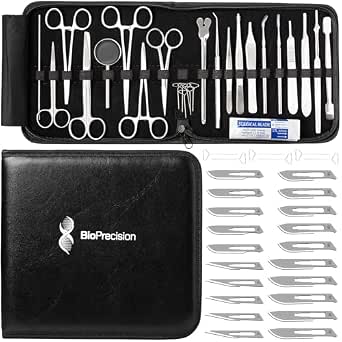 | Best Premium-Grade Assortment | Piece count: 46 | Material: Certified German stainless steel | Included: 3 scalpel handles, 20 sterile blades, scissors, forceps, tissue clamps, and tissue probes | VIEW LATEST PRICE | See Our Full Breakdown |
| United Scientific 14-Piece Precision Dissection Kit |  | Best for Compact Classroom Kits | Instrument count: 14 | Stainless steel instruments: 8 | Included tools: Dissecting scissors, scalpel with replaceable No. 22 blade, straight and curved teasing needles, dropping pipet, 6-inch transparent vinyl ruler, and T-pins | VIEW LATEST PRICE | See Our Full Breakdown |
| SURGHAUS MEDICAL Anatomy Dissection Kit with Stainless Steel Tools and Carrying Case |  | Best for Medical Training | Material: Stainless steel | Item weight: 1.5 pounds | Package dimensions: 12 x 10 x 4 inches | VIEW LATEST PRICE | See Our Full Breakdown |
| DEXSUR Stainless Steel Dissection Kit, 7-Piece |  | Best for Scalpel-Focused Practice | Number of items: 7 | Material: Stainless steel | Included components: Scalpel knives | VIEW LATEST PRICE | See Our Full Breakdown |
| SurgicalOnline 11-Piece Anatomy Student Dissection Kit |  | Best for a Clearly Listed Starter Assortment | Number of pieces: 11 | Material: Stainless steel | Included tools: Groove director, mosquito forceps, dissecting tissue forceps, surgical scissors, dissecting spatula, two thumb tissue forceps, and dissection chain hooks | VIEW LATEST PRICE | See Our Full Breakdown |
| dissection kits for student | Material |
|---|---|
| DEXSUR 30-Piece Stainless Stee | — |
| Dunzoom Biology Dissection Kit | — |
| 18-Piece Student Dissection Ki | Stainless steel |
| DR Instruments Budget Dissecti | — |
| Student Classroom Dissection S | — |
| Core Flex 38-Piece Dissection | Medical-grade stainless steel |
| DR Instruments 24-Piece Biolog | Stainless steel |
| DR Instruments Gross Anatomy D | — |
| DR Instruments Dissecting Kit | — |
| BioPrecision 46-Piece Surgical | Certified German stainless steel |
| United Scientific 14-Piece Pre | — |
| SURGHAUS MEDICAL Anatomy Disse | Stainless steel |
| DEXSUR Stainless Steel Dissect | Stainless steel |
| SurgicalOnline 11-Piece Anatom | Stainless steel |
More Details on Our Top Picks
DEXSUR 30-Piece Stainless Steel Dissection Kit
The 30 stainless steel tools make this a strong fit for students who want a wider selection than a small starter kit can offer, while the carrying case helps keep the set together between classes. Compared with the DR Instruments Budget Dissection Kit, DEXSUR supplies many more pieces and specifies stainless steel for both handles and blades, giving students more tool options for school assignments. That breadth has a tradeoff: the listing does not identify the individual tools, so buyers cannot check whether a particular instrument is included before ordering. The tools are reusable and can be sterilized, but the care instructions say hand wash only, which adds cleanup time. I’d choose it for students who expect repeated coursework, not for someone seeking a clearly itemized beginner set.
Pros:- Includes 30 dissection tools in a carrying case
- Stainless steel handles and blades are specified
- Reusable tools can be sterilized
- Designed for school use
Cons:- Individual tools are not listed in the product details
- Care instructions specify hand washing only
- The 30-piece count may be more than needed for occasional introductory work
Best for: High school or college biology students who want a large, reusable stainless steel set for recurring school dissection assignments.
Not ideal for: First-time students who need a clearly listed tool inventory, or anyone who wants instruments that can be cleaned in a dishwasher.
- Brand:DEXSUR
- Model:DS03DISKIT
- Number of pieces:30
- Handle material:Stainless steel
- Blade material:Stainless steel
- Blade length:8.5 inches
- Care instructions:Hand wash only
- Recommended use:Schools
Our verdict“Choose DEXSUR if you want a substantial reusable tool set for schoolwork and can accept an unspecified tool list and hand washing.”
Dunzoom Biology Dissection Kit, 2 Sets of 32 Pieces
For partners who want matching equipment, this bundle supplies two separate 32-piece kits, each with its own clear case. That makes it more practical for paired study than the Student Classroom Dissection Set, where instruments are shared between students in a class. The listed contents—such as T-pins, blades, dissecting needles, forceps, and a ruler—also point to a wider range of specimen work than the seven-piece DR Instruments starter set. The main uncertainty is material: the listing does not clearly say what each tool is made from, so I would not pick it over the DEXSUR 30-piece set if stainless steel construction is a priority. Blades and needles also call for careful storage and adult or instructor oversight. It suits partners or a small home study group better than a buyer seeking one minimal kit.
Pros:- Provides two complete kits, each with a clear storage case
- Each set has 32 pieces
- Includes T-pins, multiple blades, needles, and other specimen tools
- Useful for plant and animal specimen study
Cons:- Tool materials are not clearly identified
- Blades and needles need careful handling and secure storage
- Two full sets may be unnecessary for a student working alone
Best for: Two biology students, lab partners, or a household with two learners who each need a separately stored kit.
Not ideal for: Students who require confirmed stainless steel tools, or beginners who need a minimal set with fewer sharp accessories.
- Sets included:2
- Pieces per set:32
- Listed tools and accessories:T-pins, dissecting needles, scissors, forceps, dropper, ruler, blades, and label stickers
- Storage:Clear case for each kit
- Product dimensions:7.48 x 7.48 x 6.3 inches
- Item weight:12.3 ounces
- Manufacturer:Dunzoom
- Model number:GON-Dunzoom-7569
Our verdict“Pick Dunzoom when two learners need separate, broadly equipped kits, but choose a set with specified materials if construction details matter more.”
18-Piece Student Dissection Kit
This kit balances a useful set of 12 reusable stainless steel tools with six disposable scalpel blades, making it a focused choice for students practicing dissection techniques. Its zippered case with tool loops gives each instrument a place, a practical advantage over the DR Instruments Budget kit’s single-fold vinyl case for students who want a zip closure. Compared with the DEXSUR 30-Piece Stainless Steel Dissection Kit, this set is smaller and more explicit about its mix of reusable tools and replacement blades; DEXSUR offers more pieces but does not list them individually. The narrower scope can be a benefit for individual coursework, though it is less suited to a class or partners needing duplicate equipment. Disposable blades also mean students must handle and dispose of them safely.
Pros:- Includes 12 reusable stainless steel tools
- Comes with six disposable scalpel blades
- Zippered case has loops to organize and secure tools
- Piece count and tool/blade breakdown are clearly stated
Cons:- Smaller assortment than the 30-piece DEXSUR kit
- Disposable blades require safe handling and disposal
- The listing positions it for dissection practice rather than broader uses
Best for: An individual high school or college student who wants an organized practice kit with reusable tools and a small supply of blades.
Not ideal for: Teachers equipping a class, or students who want a larger tool assortment or do not need disposable blades.
- Total pieces:18
- Reusable tools:12
- Disposable scalpel blades:6
- Material:Stainless steel
- Case:Black zippered carrying case
Our verdict“Choose this kit for individual practice when an organized case and a defined mix of reusable tools and blades matter more than a large assortment.”
DR Instruments Budget Dissection Kit, 7-Piece
The seven-piece lineup covers familiar introductory tasks without asking a new student to sort through dozens of instruments: it includes a scalpel, forceps, scissors, dropper, two teasing needles, and a ruler. The itemized contents make it easier to judge the fit than the DEXSUR 30-Piece Stainless Steel Dissection Kit, whose individual tools are not listed. A single-fold vinyl case with instrument loops keeps the basics together, and the set is aimed at high school and college beginners working with preserved specimens. Its compact scope is also its limitation: compared with the 18-Piece Student Dissection Kit, it offers fewer tools and does not include a stated supply of disposable blades. Material details are mixed—the scalpel is chrome-plated, while the description does not specify stainless steel for every instrument.
Pros:- Lists seven basic instruments suited to introductory dissection
- Includes a scalpel, forceps, scissors, dropper, teasing needles, and ruler
- Instrument loops help keep tools organized in the case
- Designed for high school and college beginners
Cons:- Limited to seven pieces compared with larger student kits
- The material of every instrument is not specified
- No disposable blade supply is listed
Best for: A high school or college student taking an introductory course who needs a clearly listed set of basic instruments for preserved specimens.
Not ideal for: Students who want a large selection, confirmed stainless steel construction for every tool, or disposable replacement blades included.
- Brand:DR Instruments
- Set size:7 pieces
- Contents:Chrome-plated scalpel, fine-point forceps, scissors, glass dropper with rubber bulb, two teasing needles, and 6-inch plastic ruler
- Case:Black single-fold vinyl case with instrument loops
- Scissors length:4.5 inches
- Forceps length:4.5 inches
- Manufacturer part number:60
Our verdict“Choose this starter set when you want a clearly itemized, basic kit for an introductory course rather than a broad collection of tools.”
Student Classroom Dissection Set
Unlike the individual kits in this roundup, this set is built around classroom distribution: it supplies instruments for 40 students working in pairs and stores them in a Gratnells tray with six compartments and a snap-on lid. That makes it a more direct fit for a teacher organizing introductory middle or high school lessons than buying several Dunzoom two-kit bundles, which are packaged for smaller groups. The tray format can help keep classroom supplies together between lessons, but the class capacity assumes students share instruments in pairs; it does not provide a dedicated kit for every learner. At 6.1 pounds and 17 inches long, it is also a sizable classroom supply rather than a personal carry case. I’d select it for a teacher managing group work, not for an individual student shopping for a portable kit.
Pros:- Provides instruments for 40 students working in pairs
- Designed for introductory middle and high school biology
- Six-compartment insert helps organize classroom instruments
- Snap-on lid supports consolidated storage
Cons:- Students share instruments in pairs rather than receiving individual kits
- Tray is larger and less portable than personal carrying cases
- The listed product details do not specify the individual instruments
Best for: Middle and high school biology teachers equipping a class of 40 students for introductory dissection activities in pairs.
Not ideal for: Individual students, small study groups, or instructors who need one complete, separately stored kit per student.
- Class capacity:40 students working in teams of 2
- Storage:Gratnells tray with 6-compartment insert and snap-on lid
- Dimensions:17 x 12.3 x 3.1 inches
- Weight:6.1 pounds
- Manufacturer:Carolina Biological Supply Company
- Intended course level:Introductory middle and high school biology
Our verdict“Choose this set for a teacher organizing pair-based dissection lessons, not for a student who needs a personal kit.”
Core Flex 38-Piece Dissection Kit for Medical and Veterinary Students
The Core Flex is a strong fit for students who want a wide selection of tools without carrying a large case. Its 18 reusable stainless steel instruments and 20 replacement blades give it a broader supply of blades than the DR Instruments 24-Piece Biology Dissection Kit, while its case measures just over seven inches across. That compact format suits students moving between classes or lab rooms. The tradeoff is that the product description does not identify each instrument, so buyers should check their course list before relying on it as a complete class kit. The blades are consumables, not reusable tools, and this set is framed for educational and laboratory work rather than advanced specialty procedures. I’d rank it above simpler starter kits for breadth, but below a course-matched set when exact tool requirements matter.
Pros:- Combines 18 reusable instruments with 20 scalpel blades
- Compact case is easy to carry between class and lab
- Stainless steel tools are described as rust-resistant
- Tools can be cleaned with alcohol or sterilized
Cons:- The exact types of the 18 reusable instruments are not specified
- Scalpel blades must be replaced rather than reused
- Its broad educational-use positioning may not match specialized course requirements
Best for: Medical or veterinary students who want a compact kit with many reusable instruments and a substantial supply of blades.
Not ideal for: Students whose lab requires a named, specific instrument list, since the included tools are not itemized in the supplied description.
- Piece count:38
- Reusable tools:18
- Scalpel blades:20
- Material:Medical-grade stainless steel
- Package dimensions:7.32 × 7.17 × 1.1 inches
- Item weight:14.9 ounces
- Manufacturer:Core Flex
Our verdict“Choose the Core Flex if you want a portable, broad tool selection with ample replacement blades and can verify the instrument mix against your course list.”
DR Instruments 24-Piece Biology Dissection Kit with Stainless Steel Tools and Case
For biology students working with pinned specimens, the standout here is not its piece count but its 12 T-pins. That makes the DR Instruments 24-Piece kit more purpose-built for classroom dissections than the Core Flex 38-Piece kit, whose description emphasizes a larger general instrument and blade selection without listing pins. The included ruler, dropper, probes, and five #22 replacement blades also cover common lab tasks, and the slim hard case is practical for school storage. Its narrower, clearly stated tool list is useful when it matches a course, though it offers fewer blades than Core Flex and less instrument variety than the BioPrecision 46-Piece kit. Stainless steel still needs careful cleaning and drying to help limit rust, and blade handling calls for care.
Pros:- Includes 12 T-pins for pinning specimens
- Five replacement #22 scalpel blades are included
- Tool list names common biology-lab instruments
- Slim, hard, semi-transparent case supports storage and transport
Cons:- Five replacement blades provide less spare capacity than the Core Flex kit
- Stainless steel instruments need thorough cleaning and maintenance
- Scalpel blades require careful handling and eventual replacement
Best for: High school and college biology students whose labs use T-pins to secure specimens during dissection.
Not ideal for: Medical or veterinary students seeking a larger instrument assortment or a high supply of replacement blades.
- Item count:24
- Material:Stainless steel
- Included tools:Forceps, exploration probe, scissors, teasing needle, ruler, glass dropper, and scalpel handle
- Scalpel blades:5 #22 blades
- T-pins:12
- Case:Hard, semi-transparent, autoclavable
- Intended use:Biology, anatomy, and zoology education
- Manufacturer part number:28936PCT
Our verdict“Pick this kit for a biology course where T-pins and a clearly listed set of classroom tools matter more than a large blade supply.”
DR Instruments Gross Anatomy Dissection Kit for Medical Students, 21-Piece
This set is aimed more directly at gross anatomy coursework than the general biology-oriented DR Instruments 24-Piece kit. Its listed contents include a cartilage knife and hemostatic forceps alongside familiar basics such as scissors, a ruler, probe, and scalpel handle, giving medical, pre-med, nursing, and PA students a course-focused mix. The small zippered case is easy to carry, though its listed dimensions leave less room than the larger BioPrecision 46-Piece kit, which provides individual slots and a broader assortment. That bigger kit may suit students who need more tools, but this 21-piece option is less cumbersome for foundational labs. Its main limitation is course fit: the description does not say which exact curricula it covers, and the instrument selection may not satisfy every instructor’s list.
Pros:- Includes anatomy-focused items such as a cartilage knife and hemostatic forceps
- Covers common tools used in foundational gross anatomy labs
- Compact zippered case is easy to carry to class
- Designed for several medical and allied health student groups
Cons:- The instrument mix may not match every course requirement
- Smaller assortment than the BioPrecision 46-Piece kit
- The supplied details do not specify the case material or individual tool materials
Best for: Medical, pre-med, nursing, PA, and allied health students who need common instruments for foundational gross anatomy labs.
Not ideal for: Students whose course specifies a detailed instrument list or who need the broader assortment offered by the BioPrecision 46-Piece kit.
- Number of pieces:21
- Model:10GSME
- Contents:Teasing needles, scissors, cartilage knife, forceps, scalpel handle and blade, probe, hemostatic forceps, ruler, and zippered case
- Case dimensions:4.5 × 7.5 × 0.75 inches
- Case weight:0.70 pounds
- Assembly:Assembled in USA
Our verdict“Choose this compact kit for foundational medical or allied health anatomy labs after confirming its tool list meets your instructor’s requirements.”
DR Instruments Dissecting Kit – Student
Beginners usually benefit more from a manageable set of basics than from dozens of tools they may not use. This DR Instruments kit keeps the selection approachable: a scalpel, scissors, two teasing needles, ruler, glass dropper, and pipet cover common introductory specimen tasks. Compared with the DR Instruments 24-Piece Biology Dissection Kit, it has a simpler tool mix and no listed T-pins or replacement blades, but that smaller scope may suit a first classroom or field set. Its folding vinyl case keeps the tools together and portable. The limits are real: students progressing into advanced anatomy may need additional instruments, and the teasing needles have plastic handles described as less sturdy than metal. I’d choose it for learning basic handling, not as a long-term substitute for a course-specific kit.
Pros:- Includes core tools for introductory specimen work
- Stainless steel instruments are suited to repeated classroom use
- Compact single-fold case keeps tools organized for transport
- Includes both a glass dropper and a pipet
Cons:- Basic selection may not cover higher-level study or course-specific requirements
- Teasing needles have plastic handles that may feel less sturdy than metal
- Does not list replacement scalpel blades or T-pins
Best for: First-time biology students or beginners studying frog, fish, worm, and similar specimens who need a basic portable set.
Not ideal for: Advanced anatomy students or anyone whose lab requires pins, clamps, multiple blades, or other specialized instruments.
- Item count:1 kit
- Included tools:Scalpel, 4.5-inch scissors, two teasing needles, 6-inch ruler, glass dropper with rubber bulb, and pipet
- Tool material:Surgical stainless steel
- Case material:Black vinyl
- Case style:Single-fold carrying case
- Educational objective:Observation skills
- Number of packs:1
Our verdict“This is a sensible first kit for basic specimen work, but students with advanced or tightly specified lab requirements should choose a more specialized set.”
BioPrecision 46-Piece Surgical-Grade Dissection Kit
Among these five, the BioPrecision offers the broadest stated assortment, making it the strongest fit for students who expect to work across varied anatomy labs. It includes three scalpel handles and 20 sterile blades, plus scissors, forceps, clamps, and probes; its lined case assigns each instrument an individual slot, which helps keep a larger kit organized. Compared with the Core Flex 38-Piece kit, it adds eight listed pieces and names several instrument categories, while the Core Flex is lighter and more compact. The BioPrecision’s German stainless steel and lifetime replacement guarantee may appeal to students planning repeated use. The tradeoff is size and specificity: at 1.15 pounds it is the heaviest option here, and the description leaves several instrument types and quantities unclear. Verify course requirements before buying.
Pros:- 46-piece assortment includes three scalpel handles and 20 sterile blades
- Lined case has individual slots for instrument organization
- Uses certified German stainless steel
- Manufacturer offers a lifetime replacement guarantee
Cons:- Heavier and larger than the Core Flex 38-Piece kit
- Several instrument types and quantities are not specified
- Broad, specialized assortment may exceed a beginner’s course needs
Best for: College, medical, or veterinary students who need a broad instrument assortment, organized storage, and a replacement guarantee for recurring lab work.
Not ideal for: Beginners seeking a simple starter set or students prioritizing a light, compact case over tool variety.
- Piece count:46
- Material:Certified German stainless steel
- Included:3 scalpel handles, 20 sterile blades, scissors, forceps, tissue clamps, and tissue probes
- Package dimensions:8.11 × 7.95 × 1.34 inches
- Item weight:1.15 pounds
- Manufacturer:BioPrecision
- Replacement coverage:Lifetime replacement guarantee
Our verdict“Choose BioPrecision for repeated, varied anatomy work when you value a large organized set and can confirm the unspecified tools match your course.”
United Scientific 14-Piece Precision Dissection Kit
The 14-piece count and small hard case make this a practical pick for students who need a portable assortment rather than a large lab set. Eight tools are stainless steel, and the listed contents include scissors, a scalpel with a replaceable No. 22 blade, teasing needles, a pipet, ruler, and T-pins. Compared with the larger SURGHAUS MEDICAL Anatomy Dissection Kit, this United Scientific kit takes up less space and is easier to carry between classes, but it offers less clearly specified instrument variety and no zippered organizer. The description also repeats dissecting scissors in its contents, so buyers cannot confidently infer every item in the 14-piece count. I would choose it for general classroom work, not for students who need a clearly itemized specialist set.
Pros:- Fourteen instruments provide a broader basic assortment than a minimal scalpel-only kit
- Eight stainless steel tools support repeated classroom use
- Hard plastic case protects and contains the tools during transport
- Includes a replaceable No. 22 scalpel blade, ruler, pipet, and T-pins
Cons:- The listed contents repeat dissecting scissors, leaving some of the 14-piece assortment unclear
- Hard case offers less flexible organization than the elastic-loop case in the SURGHAUS kit
- The description does not specify the material or exact type of every instrument
Best for: Biology students who need a lightweight, compact kit for classroom assignments and basic dissection practice
Not ideal for: Medical or laboratory trainees who need a fully itemized assortment, a larger selection of specialist tools, or a zippered case
- Instrument count:14
- Stainless steel instruments:8
- Included tools:Dissecting scissors, scalpel with replaceable No. 22 blade, straight and curved teasing needles, dropping pipet, 6-inch transparent vinyl ruler, and T-pins
- Case:Hard plastic
- Package dimensions:6.77 x 3.35 x 0.71 inches
- Item weight:5.3 ounces
- Model number:UNDSET08-W
Our verdict“Choose this compact kit for routine student work if portability matters more than a fully documented instrument lineup.”
SURGHAUS MEDICAL Anatomy Dissection Kit with Stainless Steel Tools and Carrying Case
For students who need more than a starter assortment, the SURGHAUS MEDICAL kit stands out for its named instruments and organized carrying case. Its listed tools include two types of scissors, mosquito and dressing forceps, teasing needles, a probe, a scalpel handle, and six replacement blades. That detail makes it easier to match the kit to anatomy coursework than the United Scientific 14-Piece kit, whose contents list has a repeated item. The zippered case with elastic loops also gives each tool a place, though this set weighs 1.5 pounds and has substantially larger package dimensions. The fuller lineup may suit supervised laboratory training, but students seeking a light bag-friendly kit may prefer the smaller SurgicalOnline 11-Piece set. Sharp tools call for careful handling and proper instruction.
Pros:- Clearly named assortment includes scissors, several forceps, needles, a probe, and a scalpel handle
- Six replacement blades provide more blade stock than the three included with the SurgicalOnline kit
- Elastic loops in the zippered case help keep instruments sorted
- Stainless steel construction suits repeated educational and laboratory use
Cons:- At 1.5 pounds with 12 x 10 x 4-inch package dimensions, it is less portable than the United Scientific kit
- The broad assortment may be unnecessary for introductory coursework
- Sharp instruments require close attention to safe handling and storage
Best for: Medical and biology students in supervised lab courses who need a broad, clearly listed set of instruments and replacement blades
Not ideal for: Younger beginners or students prioritizing a light, compact kit for occasional classroom assignments
- Material:Stainless steel
- Item weight:1.5 pounds
- Package dimensions:12 x 10 x 4 inches
- Scalpel blades:6
- Scalpel handle:#3
- Included instruments:Blade dissecting knife, mosquito forceps, butterfly grooved director, operating scissors, iris scissors, thumb dressing forceps, splinter forceps, two teasing needles, and seeker Mall probe
- Case:Zippered carrying case with elastic loops
Our verdict“Pick this for supervised anatomy training when an organized, varied instrument set matters more than low carry weight.”
DEXSUR Stainless Steel Dissection Kit, 7-Piece
The DEXSUR 7-piece kit is the most narrowly defined option here: its listed components are scalpel knives, with interchangeable blades and ergonomic handles. Stainless steel tools that can be cleaned or sterilized point toward repeated anatomy practice, rather than a one-off classroom set. That focused approach differs from the SurgicalOnline 11-Piece kit, which names scissors, forceps, hooks, a spatula, and a groove director alongside its blades. DEXSUR may appeal to students who already have access to other instruments and want a reusable cutting-tool set, but the sparse contents description makes it difficult to know exactly what the seven pieces are. I would not treat it as a complete student dissection kit without confirming the included tools and blade supply.
Pros:- Stainless steel instruments are described as suitable for repeated use
- Interchangeable blades allow blade changes for cutting tasks
- Ergonomic handles are intended to support controlled handling
- Tools can be cleaned or sterilized
Cons:- The listed components identify only scalpel knives, so the full seven-piece assortment is unclear
- No case or blade quantity is specified in the supplied product details
- Less versatile for general coursework than the named multi-instrument SurgicalOnline set
Best for: Adult anatomy students who already have shared lab instruments and want a reusable, scalpel-centered practice set
Not ideal for: Beginning students who need a complete assortment of forceps, scissors, probes, and other basic dissection tools in one package
- Number of items:7
- Material:Stainless steel
- Included components:Scalpel knives
- Blade system:Interchangeable blades
- Handle design:Ergonomic handles
- Recommended use:Anatomy education
- Age range:Adult
- Model:KIT1023
Our verdict“Choose this only if your coursework calls for reusable scalpels and you can verify the exact contents before buying.”
SurgicalOnline 11-Piece Anatomy Student Dissection Kit
The SurgicalOnline kit earns its place through a specific, varied tool list in a relatively compact zippered case. Students get forceps, surgical scissors, a groove director, spatula, chain hooks, and three #10 scalpel blades, covering more basic tasks than the scalpel-focused DEXSUR 7-piece set. The black case has loops to keep tools together, and the stainless steel instruments are described as autoclavable and easy to clean. Its main limitation is the three disposable blades: students with frequent cutting assignments may need to replenish them, while the SURGHAUS kit includes six replacement blades and a broader specialist selection. This set makes more sense for students who want a clearly itemized general-purpose kit than for advanced laboratory training that calls for a larger instrument lineup.
Pros:- Names a varied mix of forceps, scissors, hooks, a groove director, and spatula
- Stainless steel tools are described as autoclavable and easy to clean
- Zippered case with loops helps organize and carry the instruments
- Three #10 blades are included for initial cutting tasks
Cons:- Includes only three disposable scalpel blades, fewer than the six in the SURGHAUS kit
- The 11-piece assortment is less extensive than the SURGHAUS set for specialist training
- The supplied details do not specify replacement-blade availability
Best for: Biology, botany, veterinary, or zoology students who need a compact, clearly listed assortment for routine coursework
Not ideal for: Students with frequent scalpel work or advanced lab requirements who need more replacement blades and a broader specialist instrument selection
- Number of pieces:11
- Material:Stainless steel
- Included tools:Groove director, mosquito forceps, dissecting tissue forceps, surgical scissors, dissecting spatula, two thumb tissue forceps, and dissection chain hooks
- Scalpel blades:Three disposable #10 blades
- Case:Black zippered case with tool loops
- Package dimensions:7.24 x 5.98 x 1.57 inches
- Item weight:9 ounces
- Model number:kit_142
Our verdict“Choose this for general student dissection coursework if you want a portable, well-itemized tool mix and can manage blade replenishment.”
How We Picked
I compared these kits as student tools, not as substitutes for a course supply list or professional surgical equipment. The main criteria were the stated number and type of tools, whether the listing identifies stainless steel construction, whether a storage case is included, and how clearly the kit’s intended use matches school biology, anatomy, or medical and veterinary study. A larger piece count only helped when it plausibly offered useful variety; it did not automatically earn a higher position.
The ranking favors a practical balance of breadth, clarity, and everyday student handling. That puts a moderate-sized set such as the DEXSUR 30-piece kit ahead of very small kits for general use, while compact options rank better for students whose instructors specify only a few tools. Sets with specialized course positioning or multiple collections serve narrower needs rather than replacing the general-purpose picks. Since the supplied product details do not establish blade compatibility, sterilization procedures, or exact tool dimensions, students should confirm those points with the seller and their instructor before buying.
| dissection kits for student | Material |
|---|---|
| DEXSUR 30-Piece Stainless Stee | — |
| Dunzoom Biology Dissection Kit | — |
| 18-Piece Student Dissection Ki | Stainless steel |
| DR Instruments Budget Dissecti | — |
| Student Classroom Dissection S | — |
| Core Flex 38-Piece Dissection | Medical-grade stainless steel |
| DR Instruments 24-Piece Biolog | Stainless steel |
| DR Instruments Gross Anatomy D | — |
| DR Instruments Dissecting Kit | — |
| BioPrecision 46-Piece Surgical | Certified German stainless steel |
| United Scientific 14-Piece Pre | — |
| SURGHAUS MEDICAL Anatomy Disse | Stainless steel |
| DEXSUR Stainless Steel Dissect | Stainless steel |
| SurgicalOnline 11-Piece Anatom | Stainless steel |
Factors to Consider When Choosing Dissection Kits For Students
Before choosing by piece count, I’d start with the course’s required-tool list and the way the kit will be stored and used. These broader checks can prevent buying a large set that misses one required instrument or a compact kit that cannot support the classwork.
Match the Kit to the Course List
Course requirements matter more than a kit’s general label. One biology class may need basic forceps, scissors, and a scalpel handle, while another may specify particular probe styles or blade types. Ask the instructor for the exact list before purchasing, and compare each listed item with the kit contents rather than relying on phrases such as “student” or “anatomy.” A kit can include many tools yet still omit the one instrument your lab requires. If the course list is not available, a moderately sized general set leaves more room than a minimal kit, but check return terms before ordering.
Choose Piece Count for Use, Not Appearance
Piece counts can include duplicates, handles, or accessories, so they are not a direct measure of usefulness. A small set can be easier for a beginner to learn and keep organized, while a broader set offers options for different tasks and course levels. Think about whether one student will use the kit or whether it will be shared; two sets can be more practical for a pair than one large collection. Avoid paying for extra variety if your class will not use it or if storage will be a problem. When comparing listings, look for an itemized contents list rather than making a decision from the headline number alone.
Check Storage and Transport Needs
A case is more than a convenience when tools move between home, school, and a lab. Separate slots or secured holders can reduce loose pieces and make it easier to spot a missing instrument before class. At home, a compact case may also help keep sharp tools away from children or other household members, though it does not replace safe storage practices. Check whether the listing explicitly includes a case and whether the product images or description explain how tools are held in place. If you already have a suitable lockable container, a kit without a dedicated case may still be a sensible choice.
Confirm Materials and Care Instructions
“Stainless steel” is useful information, but it does not tell you everything about finish, corrosion resistance, or how a tool should be cleaned. Ask the seller or instructor for care guidance, particularly if tools will be washed or disinfected between sessions. Drying instruments fully and storing them clean can help limit corrosion and residue, but follow the course’s safety and sanitation rules. Do not assume that a student kit is sterile or ready for clinical use. If a listing describes a kit as surgical-grade, check what that claim means for the specific instruments and the intended classroom task.
Understand Blade and Safety Requirements
Scalpel handles and blades may be sold together or separately, and compatibility can vary by handle and blade type. Verify exactly what is included before class so a missing blade does not leave the kit unusable for an assigned activity. Follow your instructor’s rules for blade installation, disposal, and transport; do not improvise with incompatible parts. For younger students or home study, adult supervision and secure storage are especially important. A larger kit is not automatically safer or more suitable for beginners, so prioritize clear handling instructions and course-approved tools.
Decide When a More Specialized Kit Makes Sense
Medical and veterinary anatomy courses may call for a broader or more specific selection than an introductory biology lab. A specialized kit can save time if its contents align closely with the syllabus, but its label alone does not prove that it meets a program’s requirements. Compare the included tools with the actual course tasks and ask whether the school supplies any instruments. For a single class with limited use, a smaller kit may cover the need without leaving many unused pieces. Students progressing through several anatomy courses may benefit from broader variety, provided the tools remain relevant and can be stored safely.
Frequently Asked Questions
Should I buy a kit before my instructor provides a supply list?
If the class begins soon, ask the instructor or department for the required list before ordering. Product titles can make kits sound suitable for a course even when one required instrument is absent. If you must buy in advance, choose a set with a clearly itemized contents list and confirm the seller’s return policy. Avoid assuming that a higher piece count covers every class requirement. You may also find that the school supplies certain tools during lab, making a full kit unnecessary.
Is a larger dissection kit a better choice for a first-time student?
Not by itself. A larger kit can give a student more tool options, but extra pieces may be confusing to manage and may go unused in an introductory class. Beginners often benefit more from a clear contents list, secure storage, and a set that matches the instructor’s demonstrations. A compact kit can be a good first purchase when the course specifies only core tools. If you expect to take more advanced anatomy courses, compare the additional instruments with those future requirements before choosing a larger set.
Do I need to buy blades separately?
That depends on the exact kit listing and the blade requirements of the course. Some listings may include handles without blades, and the compatible blade type can depend on the handle. Check the itemized contents and confirm compatibility with the instructor or seller before purchasing blades separately. Follow class rules for installation and disposal, and do not use a blade that does not fit securely. A kit’s tool count alone will not clarify whether blades are included.
Can one dissection kit be shared between two students?
Sharing may work for occasional study, but it can slow down a lab if both students need tools at the same time. Check whether the assignment calls for duplicate instruments or individual kits, and ask how tools should be cleaned between users. Dunzoom’s two-set package is one option to compare when separate collections are useful, while a single larger kit may still contain only one of each tool. Sharing also means agreeing on safe transport and storage. For graded or time-limited lab work, separate kits can be more practical.
Are student dissection kits suitable for clinical or professional use?
These products are presented as student, biology, anatomy, or educational kits, so I would not assume they meet clinical standards. A listing’s use of terms such as “surgical-grade” does not establish that every instrument is suitable for patient care or has been supplied sterile. Clinical work requires equipment approved for the specific setting, along with formal cleaning and sterilization procedures. Students should use these kits only for instructor-approved educational activities. If a program requires professional instruments, follow its equipment guidance rather than substituting a classroom set.
Conclusion
For a general student kit, I’d choose the DEXSUR 30-Piece Stainless Steel Dissection Kit as the best overall balance of tool range and manageable size. The DR Instruments 7-Piece Budget Kit is the best value-style fit for students whose class requires only basic tools, while the BioPrecision 46-Piece Surgical-Grade Kit is the best premium-style option for buyers who want the broadest stated selection, subject to checking the course list. For beginners, I’d start with the 18-Piece Student Dissection Kit or a compact seven-piece set rather than paying for unused extras. For shared use, compare the two collections in the Dunzoom Biology Dissection Kit; for students prioritizing storage, the DR Instruments 24-Piece Biology Kit with Case is the more direct match. Before ordering any of them, verify required tools, blade details, and safe-storage expectations with your instructor.
Halloween Picks

Gemmy 6-Foot Leatherface Animatronic Halloween Decoration

HOPOCO Halloween Pumpkin Fog Machine with 12 LED Colors and 4 Light Modes

Haunted Hill Farm 2-Ft. Zombie Raccoon Halloween Animatronic
As an affiliate, we earn on qualifying purchases.