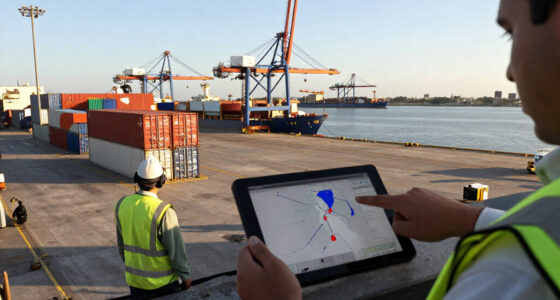
🔍 Read the full analysis: Dockworkers Facing The AI Container Wave on ThorstenMeyerAI.com

Prime made for students and young adults
- Fast, free delivery for dorm and study essentials
- Prime Video and Amazon Music included
- Member-only deals
TL;DR
Containerization sharply reduced the labor and cost required to move cargo through ports, contributing to steep declines in dockworker employment. The source traces labor agreements and strikes alongside ongoing disputes over automation; it does not establish that AI itself caused the historic job losses or provide a new AI-related announcement.
A November 23 report on container shipping’s history links the move from loose cargo to standardized boxes with sharply lower port-handling costs and major long-term declines in dockworker employment. The account, published by ThorstenMeyerAI.com, also points to labor agreements and strikes—including a 2024 East and Gulf Coast dockworkers’ strike over wages and automation—as evidence that the effects of mechanization remain contested.
Before container shipping, dockworkers moved cargo one sack, barrel or crate at a time, transferring it between trucks or trains, warehouses and ships. The report describes a 1954 voyage from Brooklyn to Bremerhaven carrying 194,582 separate items; cargo handling at both ends depended on workers manually loading and securing each piece.
The cost figures in the report show the economic incentive for a different system. In an estimate reproduced in historian Marc Levinson’s book The Box, port costs accounted for $1,163 of a $2,386 shipment carrying medicine from Chicago to Nancy, France, around 1960. Levinson’s figures put loose-cargo loading at $5.83 a ton in 1956, compared with 15.8 cents a ton for the first container ship operated by trucker Malcom McLean. The report calculates that as about 36 times cheaper.
On April 26, 1956, a crane in Newark, New Jersey, loaded 58 truck bodies onto McLean’s converted tanker, the Ideal X. The report says the key innovation was not the cargo box itself, which had earlier uses, but a system that let a box move between ship and truck without being opened. It links that shift to long-term employment declines: the Waterfront Commission’s figures put New York and New Jersey longshoremen at more than 35,000 in the early 1960s and about 3,500 in 2013; Britain’s registered dockworker count fell from 82,000 at its peak to 9,400 in 1989.
Infographic 01 · Before the box
Why the port cost more than the ocean
Before the container, every sack and crate was handled one by one. The port, not the sea, was the expensive part of a trip.
One truckload of medicine, Chicago → Nancy (France) · estimate ca. 1960 · total $2,386
Cost of loading one ton · 1956
Roughly 36 times cheaper to load (5.83 ÷ 0.158, our calculation). The loading figures are from Levinson’s own article; other authors cite them to The Box, 1st ed. (2006), p. 52.
Sources: M. Levinson, The Box, 2nd ed. (Princeton UP, 2016), ch. 1, Table 1, p. 12 (American Association of Port Authorities data); M. Levinson, The Box That Shrank the World, Works That Work No. 2.
Powered by Thorsten Meyer AI
The Workforce Cost of Containerization
Containerization changed not only how goods moved but also how many workers ports needed. Lower handling costs helped make shipping more efficient, while the reduction in manual cargo handling put pressure on jobs built around moving individual items. The employment figures cited in the report show the scale of that long-term change, though they do not isolate containerization as the sole cause of every job reduction.
The history also helps explain why automation negotiations are contentious. Workers face potential losses in hours, jobs and control over work, while employers seek productivity and lower operating costs. In 1960, West Coast dockworkers negotiated protections in exchange for allowing mechanization. The report says the agreement included a $29 million fund, income guarantees for registered workers if hours fell, retirement payments and benefits. That bargain illustrates how labor agreements can shape who bears the cost of technological change.
For readers, the connection to AI is a question of how new tools are introduced, not proof that AI has already caused the historic workforce decline. Ports may use automation and digital systems alongside container equipment, but their effects vary. The report cites a 2024 US government assessment that found denser stacking at some automated terminals, alongside slower moves and more breakdowns at some sites. Automation does not automatically mean faster operations, and employment effects depend on specific technology, contracts and operating conditions.
Popular right now

Ninja Specialty Coffee Maker with 10-Cup Carafe and Fold-Away Frother, CM401

Bose QuietComfort Wireless Noise Cancelling Headphones – Petal Pink Limited Edition

Roborock Q10 S5+ Robot Vacuum and Mop with 10,000 Pa Suction
As an affiliate, we earn on qualifying purchases.
From Loose Cargo to Standard Boxes
The source places the first major container voyage in a period when port handling was a large part of shipping costs. The Ideal X voyage in 1956 helped demonstrate that standardized cargo boxes could be transferred between transport modes as part of one system. The report cautions that the familiar story of McLean conceiving the idea while waiting at a pier has no contemporary record cited in its account, and should be treated as a legend rather than a verified fact.
Labor responses were negotiated as well as contested. On October 18, 1960, the International Longshoremen’s and Warehousemen’s Union and the Pacific Maritime Association reached the Mechanization and Modernization Agreement. According to the report’s account, employers gained latitude to mechanize, while registered workers received income, retirement and other protections. A later 134-day West Coast strike in 1971, and an East and Gulf Coast strike in 2024 over wages and automation, show that disputes over technology and working conditions have continued.
These episodes are relevant background, but they do not amount to a single, uninterrupted story of workers being replaced by machines. The agreements applied to specific groups and periods, and the source’s historical figures use different locations and dates. They describe changes in dockworker numbers; they are not a direct measure of the number of jobs lost specifically to AI.
““A four thousand mile voyage for a shipment might consume 50 percent of its costs in covering just the two ten-mile movements through two ports.””
— An expert quoted in Marc Levinson’s The Box, as reproduced in the report
What AI Has—and Has Not—Changed
The report is principally a historical account, not a new study measuring AI’s effect on port employment. It does not establish how many current dockworker jobs have been eliminated by AI, nor does it separate AI-driven changes from containerization, cranes, terminal redesign or other forms of mechanization. The historical workforce totals also cover different years and geographies, so they should not be read as a single comparable trend series.
The source refers to a 2024 US government report on terminal performance but does not provide its full title, methods or terminal-by-terminal data. It summarizes the findings as showing denser stacking but slower moves and more breakdowns at some automated terminals. The exact scale and causes of those differences, and how they compare across ports, remain unclear from the material provided.
Details of the 2024 strike are also limited in the source: it says East and Gulf Coast dockworkers struck over wages and automation, but does not supply the duration, settlement terms or current status of any related negotiations. It is not clear which new AI systems, if any, are being used at particular ports or how workers’ contracts address them.
Negotiations Will Shape Port Automation
The source does not identify a specific upcoming vote, contract deadline or deployment date. The next developments to watch are labor negotiations over automation, port operators’ plans for terminal equipment and software, and whether public assessments provide comparable performance and employment data. Those details would help distinguish promised productivity gains from results observed in day-to-day operations.
Any assessment of AI’s effect on dock work will need to identify the technology involved, the port and the period being measured, and whether jobs, hours or duties changed. Until such evidence is provided, the historic experience of containerization offers context for current debates—not a forecast that AI will produce the same outcomes.
Key Questions
What is the report’s main development?
The November 23, 2026, report recounts how container shipping reduced the cost and labor involved in port cargo handling, and relates that history to continuing labor disputes over automation.
Did AI cause the historic decline in dockworker numbers?
No. The employment declines discussed in the report followed the spread of containerization and other mechanization. The material does not show that AI caused those historical changes or quantify AI’s current effect on dock jobs.
How much cheaper was container loading in the cited comparison?
The report cites figures of $5.83 per ton for loose-cargo loading and 15.8 cents per ton for McLean’s Ideal X in 1956. It calculates the container figure as about 36 times cheaper; that comparison concerns the cited loading costs, not the total cost of shipping.
Did unions negotiate protections against mechanization?
According to the report, a 1960 West Coast agreement allowed employers greater freedom to mechanize and provided registered workers with a fund, income protections if hours fell, retirement payments and other benefits.
Are automated terminals always faster?
No. The report summarizes a 2024 US government assessment as finding denser stacking but also slower moves and more breakdowns at some automated terminals. It does not provide enough detail to generalize those findings to every port.
Source: ThorstenMeyerAI.com