📊 Full opportunity report: Estate Planning Teams Can Start With An Empty Trust Tracker on IdeaNavigator AI — validation score, market gap, and execution plan.

Prime made for students and young adults
- Fast, free delivery for dorm and study essentials
- Prime Video and Amazon Music included
- Member-only deals
TL;DR
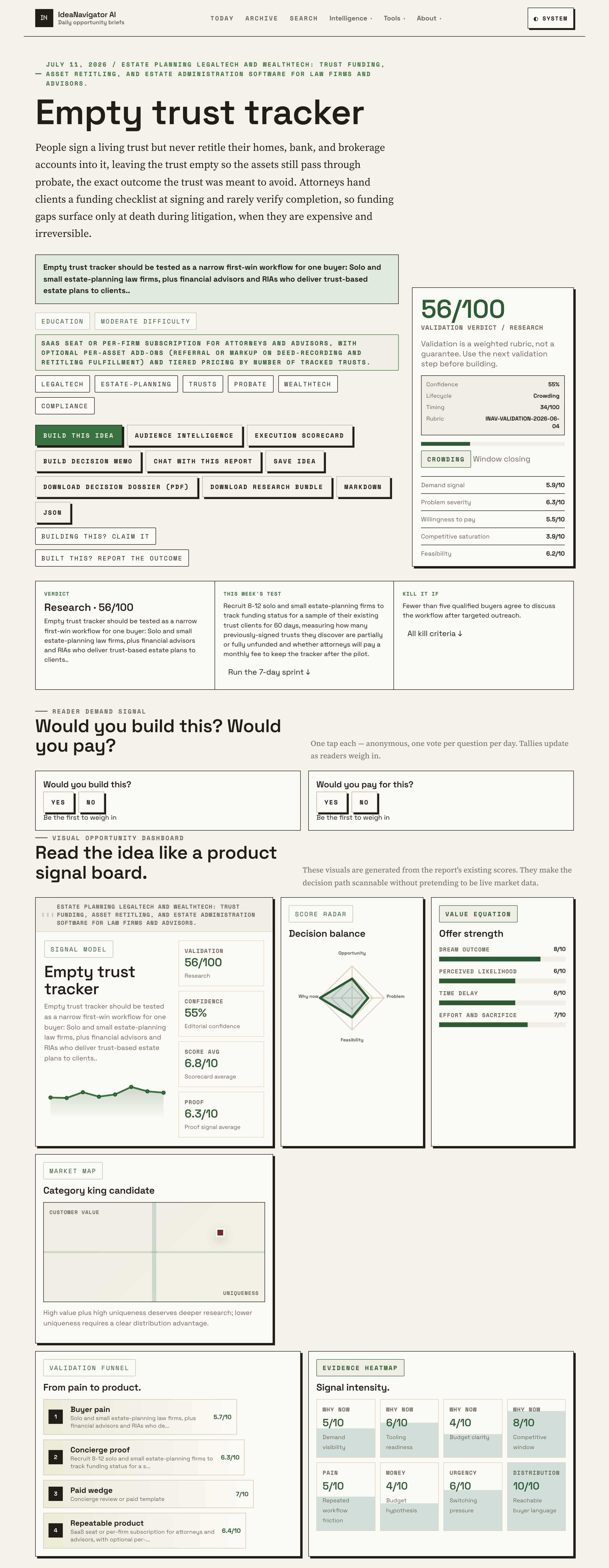
IdeaNavigator AI describes an empty trust tracker as a proposed workflow for small estate-planning firms and financial advisers. The concept would let teams track asset transfers, store proof and remind clients, but it has not been presented as a launched product or validated service.
IdeaNavigator AI has outlined a proposed trust-funding tracker for solo and small estate-planning firms, financial advisers and registered investment advisers. The suggested tool would help teams monitor whether clients move homes and financial accounts into living trusts, a step that can determine whether those assets are handled through the trust or may still pass through probate.
According to IdeaNavigator AI’s proposal, the concept centers on an asset checklist for each client trust. A firm would list relevant property and accounts, including real estate, bank and brokerage accounts, retirement assets, business interests and beneficiary designations. Each item could be marked pending, in progress or confirmed funded, with supporting documents such as a recorded deed or an updated account statement attached as evidence.
The proposal also suggests automated reminders to clients and a firm dashboard showing the funding status of its trusts. IdeaNavigator AI says the purpose would be to help attorneys or advisers spot trusts with unfinished transfers while the client can still address them. It suggests a subscription priced by firm or user, with tiers based on the number of trusts tracked and possible add-on revenue from deed-recording or retitling services.
These are proposed features and possible revenue models, not confirmed product capabilities or a commercial launch. IdeaNavigator AI recommends testing the concept with eight to 12 small firms over 60 days, using existing trust clients to measure how often the firms find partially or fully unfunded trusts and whether they would pay to keep using the tracker after a pilot.
Where Trust Funding Falls Through
As general estate-planning context, a living trust document alone may not put a person’s assets into the trust. Ownership or account records generally need to be updated for assets intended to be held by the trust. If those steps are missed, the trust may not accomplish the intended handling of those assets, and probate may remain relevant. IdeaNavigator AI’s proposal identifies a gap between preparing estate-planning documents and following through on the transfers they require.
For a small practice, a shared tracker could make outstanding tasks visible across multiple clients and give staff a consistent way to request and record evidence. That could help teams identify unfinished work before a client dies, when correcting ownership records may be more difficult. For clients, reminders and a clear status list could make a complicated administrative process easier to follow.
The potential benefit remains a hypothesis to test. IdeaNavigator AI provides no pilot results, adoption figures for the tracker, or evidence that reminders would lead to completed transfers. Its value would depend on whether firms can use it without adding enough administrative work to outweigh the improved visibility.
The Proposed 60-Day Pilot
IdeaNavigator AI describes trust funding as a manual step that document-drafting software does not itself complete. The proposal says attorneys may give clients a checklist when a trust is signed, but firms may not routinely verify every transfer. It also points to deed-funding services priced from $250 per deed as evidence of a paid service market; that price is presented in the proposal, not as an independently verified market survey.
The idea cites an estimate that about 11% of Americans hold a trust, but provides no underlying study, date range or definition of “hold a trust.” The figure should be read as an estimate in IdeaNavigator AI’s proposal rather than a current, independently established adoption rate. The proposal also describes estate-planning adoption and digital tools as growing in 2026 without supplying supporting measurements.
IdeaNavigator AI’s proposed validation approach is deliberately limited: recruit eight to 12 solo or small firms, track a sample of existing trust clients for 60 days, record how many trusts are found to be partly or entirely unfunded, and ask whether firms would pay a monthly fee to continue. The proposal identifies no firms, pilot dates or results.
Pilot Results Are Not Yet Available
No launched tracker or completed pilot is confirmed in IdeaNavigator AI’s available description. It does not identify a developer, participating law firms, implementation schedule, price list or integrations with legal practice systems, banks or deed-recording services. It also does not specify how client documents would be stored or who would verify that an asset had been transferred correctly.
The proposal does not establish how often unfunded trusts occur, how many such cases lead to probate, or whether the suggested dashboard would reduce missed transfers. Its estimate of trust ownership lacks a cited methodology, and its cited deed-service price does not establish the size of the market. Those questions would need evidence from a pilot or other attributable research.
A Small-Firm Trial Would Test Demand
IdeaNavigator AI’s proposed next step is to recruit eight to 12 small estate-planning firms for a 60-day trial using a sample of existing clients. The suggested measures are the share of tracked trusts found to have incomplete funding and firms’ willingness to pay a monthly subscription after the trial. The proposal provides no recruitment announcement or start date, so whether that pilot will proceed remains unknown.
If a trial takes place, useful results would include how firms define “funded,” what evidence they accept, how often clients respond to reminders and how much staff time tracking requires. Those details would help show whether the service can fit into routine practice and whether its proposed dashboard offers enough value to support recurring fees.
Source: IdeaNavigator AI
Key Questions
What is an empty trust tracker?
It is a proposed tool for tracking whether a client has moved intended assets into a living trust. IdeaNavigator AI’s suggested checklist includes real estate and financial accounts, with status labels and supporting documents.
Has the tracker launched?
IdeaNavigator AI’s available description outlines a product idea and a possible pilot. It does not confirm a commercial launch, developer or participating firms.
Why can an unfunded trust matter?
A trust document does not by itself update ownership records. If intended assets are not transferred into the trust, they may not be handled through it as planned, and probate may still apply.
How would the idea be tested?
IdeaNavigator AI’s proposal calls for a 60-day trial with eight to 12 small firms, tracking existing client trusts and asking whether firms would pay to continue using the service.
Source: IdeaNavigator AI
Fall Picks
fall essentials
As an affiliate, we earn on qualifying purchases.