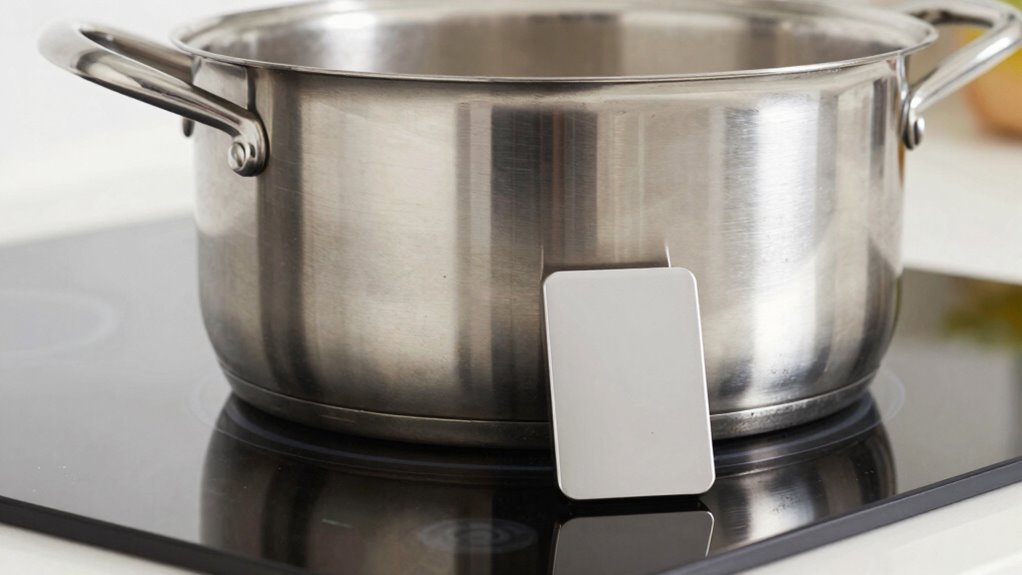

To check if your cookware is compatible with induction stoves, use a simple magnet test. Place a magnet on the bottom of your pots and pans; if it sticks firmly, your cookware likely works with induction. If it doesn’t, it’s probably incompatible. Many ceramic and glass options can work if they contain a ferromagnetic layer, and labels or symbols can help identify induction-ready items. Keep exploring to discover more helpful tips.
Key Takeaways
- Use a small magnet to test the cookware’s bottom; if it sticks firmly, it’s likely induction-compatible.
- Ceramic or glass cookware with ferromagnetic material can work on induction; test with a magnet first.
- Look for manufacturer labels or symbols indicating induction compatibility for reliable confirmation.
- Non-magnetic cookware, like pure ceramic or glass, won’t work unless combined with a ferromagnetic base.
- Transitioning from gas to induction may require replacing non-compatible cookware identified through the magnet test.
Are you wondering if your cookware works with an induction stove? It’s a common question, especially if you’re shifting from a gas stove or have a collection of ceramic cookware. Induction cooking relies on magnetic fields to heat your pots and pans directly, making it energy-efficient and fast. But not all cookware is compatible, so it’s essential to know how to tell if yours will work without guesswork or trial and error.
Wondering if your cookware suits an induction stove? Test with a magnet to find out easily.
The most straightforward method is the magnet test. Grab a small magnet, like a fridge magnet, and hold it against the bottom of your cookware. If the magnet sticks firmly, your cookware is likely induction-compatible. This is because induction stoves require cookware with ferromagnetic properties—materials like cast iron or certain stainless steels. If the magnet doesn’t stick, then your cookware probably won’t work on an induction stove, and you’ll need to consider alternatives.
Many people assume that ceramic cookware isn’t suitable for induction cooking. That’s not necessarily true. Ceramic cookware, especially those with a metal base or core, can be compatible if it contains ferromagnetic material. However, pure ceramic or glass cookware without any metal component won’t work with induction stoves, regardless of how attractive or durable it looks. To determine if your ceramic cookware is compatible, perform the magnet test on its bottom. If the magnet sticks, you’re good to go; if not, it’s best to use it on a gas stove or consider an induction-compatible ceramic piece with a magnetic base.
Switching from a gas stove to induction can be a smooth transition if you understand your current cookware. If you currently use gas stove cookware, such as aluminum or unmagnetic stainless steel, those won’t work on induction unless they have a magnetic layer added. Many manufacturers now produce cookware specifically labeled as induction-compatible, often with a symbol indicating so. When shopping for new cookware, look for this label to save time and ensure compatibility.
Frequently Asked Questions
Can Non-Magnetic Cookware Ever Work on Induction Stoves?
Non-magnetic cookware generally won’t work on induction stoves because induction safety relies on magnetic fields. If your cookware isn’t magnetic, it won’t generate the heat needed for cooking. However, you can use a ferromagnetic base or an induction-compatible plate to adapt your non-magnetic pots and pans. Just remember, this may affect cookware maintenance, as some materials can get scratched or damaged more easily. Always check for compatibility before cooking.
How Do I Identify if My Cookware Is Induction-Compatible Without a Magnet?
You can identify if your cookware is induction-compatible by checking its magnetic properties through compatibility testing. If a magnet sticks firmly to the bottom, it’s likely suitable for induction stoves. Coincidentally, many non-magnetic cookware isn’t compatible, but some with magnetic bases work perfectly. To be sure, perform the magnet test—if it doesn’t stick, your cookware probably won’t work on induction. This simple test saves you time and guarantees efficient cooking.
Does the Cookware Material Affect Induction Efficiency?
Yes, your cookware material affects induction efficiency. Magnetic properties are key; if your cookware has strong magnetic properties, it heats efficiently on induction stoves. Heat conductivity also matters—materials like cast iron and stainless steel transfer heat well, ensuring faster cooking. Non-magnetic materials like aluminum or copper won’t work unless they have a magnetic layer. So, choosing cookware with good magnetic properties and high heat conductivity boosts your induction cooking experience.
Are There Specific Brands Known for Reliable Induction-Compatible Cookware?
Think of induction cookware brands like trusted friends—certain names consistently earn glowing reviews. Brands like All-Clad, T-fal, and Calphalon are known for their reliable induction compatibility, backed by strong reputation and positive customer reviews. For example, many users praise All-Clad’s durability and performance. When choosing, look for brands with a solid track record, as they’re more likely to give you efficient, hassle-free cooking on your induction stove.
Can I Use Aluminum or Copper Cookware on Induction Stoves?
You can’t use aluminum or copper cookware on induction stoves unless they have magnetic properties, like a ferromagnetic layer. Material limitations mean these metals don’t naturally work with induction because they lack magnetic properties. To check, use a magnet; if it sticks, your cookware is compatible. Otherwise, you’ll need an induction-compatible layer or choose cookware specifically designed for induction cooking to guarantee proper heat transfer.
Conclusion
Think of induction cookware like a key and your stove as a lock. When the magnet sticks, it’s the perfect fit, activating efficient cooking. If it doesn’t, it’s like trying to fit a square peg into a round hole — it just won’t work. So, before you start cooking, do the magnet test. It’s a simple way to guarantee your cookware and stove are in harmony, turning your kitchen into a well-orchestrated symphony of heat and flavor.