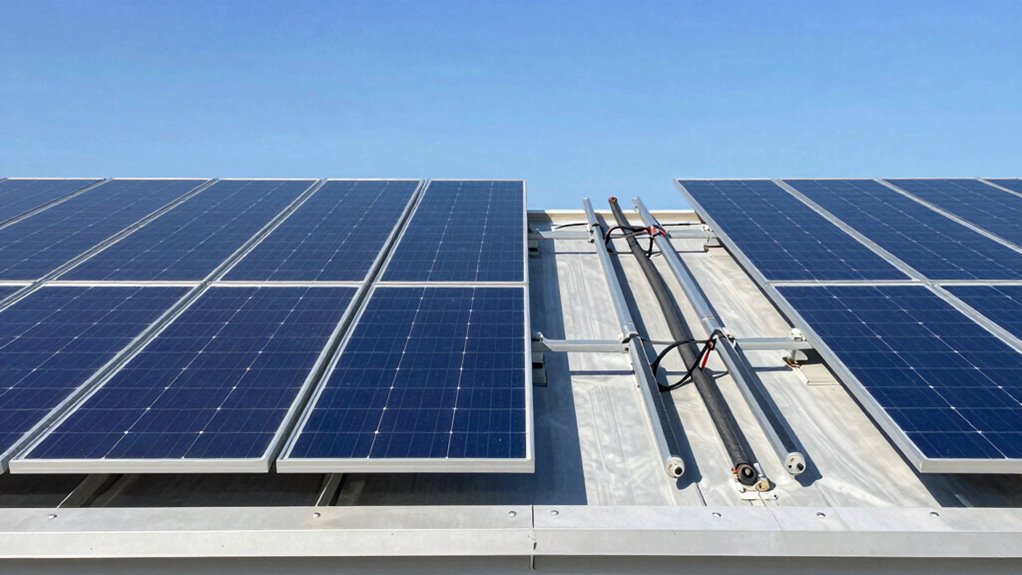

When connecting solar panels, choosing between series and parallel depends on your needs. In series, you link panels end-to-end, boosting voltage while keeping current the same, which is good for long-distance wiring and inverter compatibility. Parallel connections combine all positives and negatives, increasing current but keeping voltage steady, ideal for shading situations and smaller setups. If you want to optimize your system’s performance, understanding these differences will help you make smarter choices about your solar setup.
Key Takeaways
- Series connection increases voltage while current stays the same; parallel increases current with constant voltage.
- Series wiring is ideal for long-distance transmission and inverter matching; parallel resists shading impact.
- Match panel wiring with inverter specifications for optimal efficiency and system performance.
- Series setups suit higher-voltage batteries; parallel configurations are better for higher current storage.
- Understanding the differences helps design a reliable, efficient solar system suited to your energy needs.
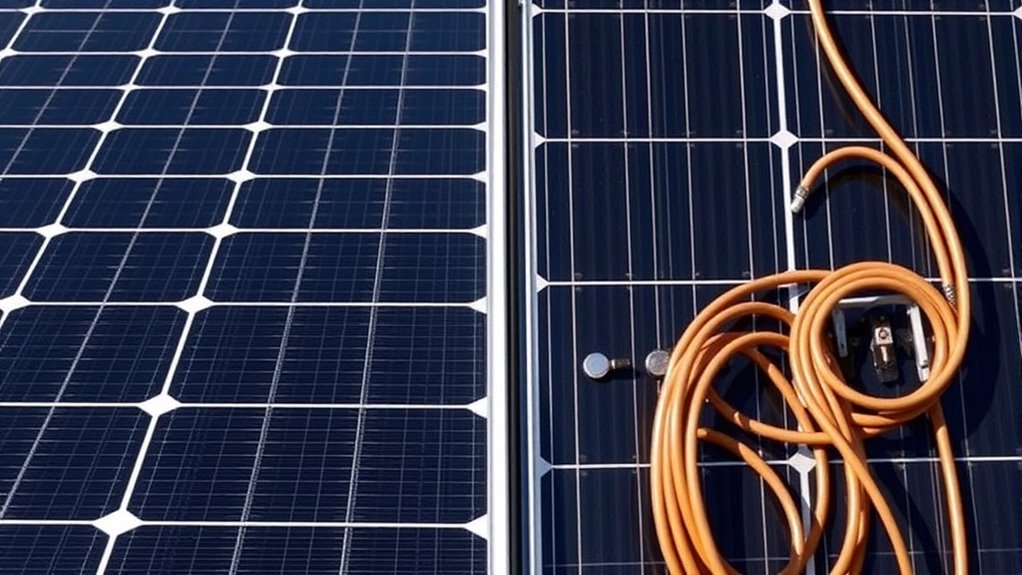
Ever wondered how solar panels turn sunlight into electricity? The process begins when sunlight hits your solar panels, generating direct current (DC) electricity. To make this power usable in your home, it first needs to pass through an inverter, which converts DC into alternating current (AC). One vital aspect that influences how efficiently your system works is how you connect your solar panels—either in series or parallel. Understanding these configurations helps you optimize your setup, especially when considering battery storage and inverter types.
Connecting panels in series involves linking their positive and negative terminals end-to-end, creating a single string. This setup increases the voltage, which can be advantageous if you want to reduce power loss over long distances or match the input requirements of your inverter. However, the total current remains the same as a single panel’s current. The benefit here is that higher voltage systems tend to be more efficient, especially when paired with certain inverter types designed for higher voltage inputs. But keep in mind, if one panel underperforms—due to shading or dirt—the entire string’s output drops, since the current is limited by the weakest panel.
Connecting panels in series increases voltage but keeps current the same, improving efficiency over long distances.
On the other hand, connecting panels in parallel involves linking all positive terminals together and all negative terminals together. This configuration keeps the voltage similar to that of a single panel but increases the overall current. Parallel connections are typically better if you want to maximize current, especially when your panels are smaller or spaced out, making them less susceptible to shading issues. When it comes to inverter types, some inverters are optimized for parallel setups, offering better flexibility and resilience to panel performance variability.
Battery storage also plays a role in how you connect your panels. If you’re planning to store excess energy in batteries, the system’s voltage and current become critical. Series configurations help achieve higher voltage levels, which are often necessary for certain battery systems and inverter types designed for higher voltage inputs. Conversely, a parallel setup might be preferable if your battery bank prefers lower voltage and higher current.
Choosing the right connection method depends on your specific needs—consider factors like shading, distance from panels to inverter, and your battery setup. Inverters are designed to handle different input configurations, so matching your panel wiring to your inverter’s specifications is essential. Whether you opt for series or parallel, understanding how these configurations influence voltage, current, and compatibility with your battery storage and inverter types ensures you maximize your solar energy system’s efficiency and longevity.
Frequently Asked Questions
How Do Temperature Changes Affect Solar Panel Performance?
Temperature effects can considerably impact your solar panel’s performance. When temperatures rise, panel efficiency tends to decrease because high heat reduces the ability of solar cells to convert sunlight into electricity effectively. Conversely, cooler temperatures help maintain ideal efficiency. You should guarantee proper ventilation and consider panels with good heat dissipation to minimize temperature effects and maximize your solar energy output.
Can Mixed Series and Parallel Wiring Improve Efficiency?
Yes, mixed series and parallel wiring can improve efficiency by optimizing wiring configurations for your setup. By combining both, you can balance voltage and current, reducing power loss and enhancing overall performance. This approach allows you to tailor your solar system to specific shading or space constraints, maximizing efficiency maximization. Just guarantee your panels and inverter are compatible with mixed wiring to avoid issues and get the best results.
What Safety Precautions Are Needed for Solar Panel Wiring?
You should always follow proper grounding practices to prevent electrical shocks and guarantee system safety. Make sure all wiring is securely insulated and connections are tight. Regularly check inverter safety features, such as circuit breakers and fuses, to protect against overloads. Keep your system away from water and avoid working in wet conditions. By prioritizing grounding and inverter safety, you minimize risks and keep your solar setup functioning safely and efficiently.
How Does Shading Impact Series Versus Parallel Configurations?
They say, “A chain is only as strong as its weakest link.” Shading effects hit series configurations hardest because even a little shade on one panel reduces the entire string’s output. In parallel setups, shading affects only the shaded panel, causing less overall impact. Be aware of panel mismatch, which can worsen shading effects, especially in series, so plan your layout carefully to maximize sunlight and minimize shading issues.
Are There Differences in Lifespan Between Series and Parallel Setups?
You’ll find that lifespan differences between series and parallel setups are minimal, but wiring durability plays a role. Properly insulated wiring in both configurations helps prevent wear and tear, extending battery longevity. Series wiring might experience more stress on individual connections, potentially affecting durability, while parallel wiring distributes current more evenly. Regular maintenance and quality components ensure your system remains efficient longer, regardless of the configuration you select.
Conclusion
Now that you understand the key differences between series and parallel connections, you’re one step closer to optimizing your solar setup. But which configuration will truly maximize your efficiency? The choice isn’t always straightforward, and the decision could impact your system’s performance more than you realize. Ready to explore which setup fits your needs best? Stay tuned — the next step could change the way you harness solar power forever.