
To quickly find your biggest energy drains, start by checking your utility bills to see your overall consumption. Then, identify major appliances like refrigerators, air conditioners, and water heaters that use the most power. Use a smart meter or monitor their usage with a manual tracker. Turning off unused devices and adjusting settings can also reveal savings. Keep exploring to discover more simple ways to reduce your household’s energy load effectively.
Key Takeaways
- Review your energy bills to identify peak consumption periods and overall usage patterns.
- Use a smart meter or plug-in energy monitor to measure each appliance’s power draw quickly.
- Focus on major appliances like refrigerators, air conditioners, and water heaters during peak use times.
- Turn off or unplug appliances when not in use to gauge their impact on total load.
- Track operation durations and energy ratings to pinpoint the biggest energy consumers efficiently.
A household load audit is a practical way to identify where your home consumes the most energy and find opportunities to save. When you conduct an audit, you’re essentially pinpointing the major sources of energy use within your household. This process helps you understand which appliances or systems are the biggest culprits, so you can target your efforts for energy conservation more effectively. By analyzing your energy consumption, you’ll see where small changes can make a big difference, saving you money and reducing your environmental footprint.
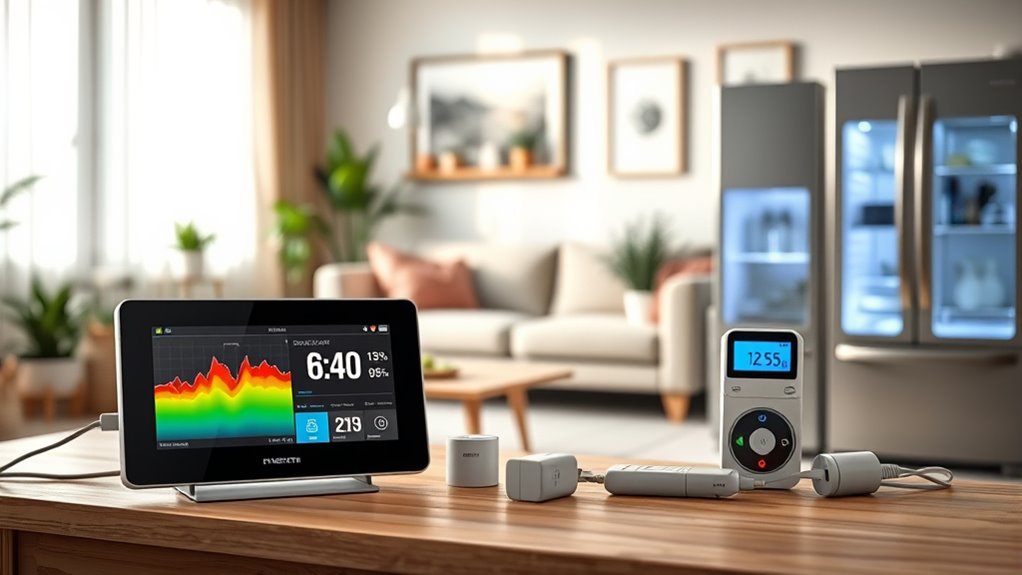
Start by gathering your energy bills to get a baseline of your overall consumption. Then, take a close look at each major appliance—refrigerators, air conditioners, water heaters, and laundry machines—since these typically account for the bulk of household energy use. You can track their operation times and energy ratings, either manually or with a smart meter. Many utility companies also offer detailed energy reports that break down your usage, which can be a helpful starting point. Once you have this data, you’ll see which appliances are the biggest energy hogs.
Gather energy bills and monitor major appliances to identify top energy consumers in your home.
Next, focus on appliance efficiency. Replacing old, inefficient appliances with newer, energy-efficient models can considerably cut your energy consumption. Look for products with high ENERGY STAR ratings—they’re designed to use less power without sacrificing performance. For example, switching to a modern refrigerator or air conditioner with better insulation and advanced compressor technology can save you hundreds of dollars annually in energy costs. Additionally, simple maintenance like cleaning filters, sealing leaks, and ensuring proper insulation can improve appliance efficiency without the need for costly replacements.
You can also implement behavioral changes to enhance energy conservation. For instance, turning off appliances when not in use, adjusting thermostats by a degree or two, and using appliances during off-peak hours can all reduce your household load. These small adjustments, when combined, have a substantial impact over time. The key is to be mindful of your daily habits and find ways to use energy more wisely.
Finally, keep a record of your findings and improvements. This not only helps you track your progress but also motivates you to continue making smarter choices. A household load audit isn’t a one-time effort; it’s an ongoing process that helps you stay aware of your energy use and find new ways to improve energy conservation and appliance efficiency. Being aware of contrast ratio and other technical specifications can help you select the most efficient equipment and optimize your energy savings. By being proactive, you can reduce your utility bills, extend the lifespan of your appliances, and contribute to a more sustainable environment.
Frequently Asked Questions
How Often Should I Perform a Household Load Audit?
You should perform a household load audit at least once a year to identify energy hogs and apply energy saving tips. Regular audits help you spot appliances that need maintenance or replacement, reducing energy waste. Keep track of your energy use, especially if you add new devices or notice higher bills. This proactive approach guarantees you maximize savings and maintain efficient appliance operation, keeping your home energy-smart year-round.
Can I Do a Load Audit Without Professional Help?
You can absolutely do a load audit without professional help, but it’s like biting off more than you can chew if you’re not careful. Start with DIY energy tips, like unplugging unused devices and using energy-efficient bulbs. For a thorough understanding of your biggest energy drains, consider a professional assessment. It’s a small investment that could save you a big chunk on your energy bill in the long run.
What Tools Are Necessary for a Quick Load Audit?
You only need basic tools like an energy monitoring device and a power meter for a quick load audit. These tools help you compare energy usage across appliances efficiently. Look for a user-friendly energy monitoring device that offers real-time data, making it easier to identify high-consuming appliances quickly. Comparing different tools guarantees you pick the best one for your needs, simplifying your household load assessment without professional help.
How Accurate Are DIY Household Load Audits?
Think of a DIY household load audit like tuning a guitar—you’ll get close but might miss a few notes. Your accuracy depends on your tools and experience. While it’s a good way to spot major energy drains, it won’t be perfectly precise. Still, it helps improve energy efficiency and extend appliance lifespan. Just remember, for critical decisions, a professional audit offers better accuracy.
Are There Specific Appliances That Typically Consume the Most Energy?
You’ll find that appliances like refrigerators, old air conditioners, and water heaters typically consume the most energy. To improve appliance efficiency, consider upgrading to energy-efficient models and using energy saving tips like unplugging devices when not in use. Regular maintenance also helps. Identifying these high-energy appliances through a household load audit allows you to target your efforts and reduce overall energy consumption effectively.
Conclusion
Conducting a household load audit helps you identify your biggest energy drain quickly and easily. Did you know that appliances like refrigerators and heating systems can account for up to 50% of your energy use? By pinpointing these major draw points, you can make smarter choices to cut costs and save power. Take a few minutes now—your wallet and the environment will thank you for it!