📊 Full opportunity report: Using Simulation To Practice IEP Negotiations At Home on IdeaNavigator AI — validation score, market gap, and execution plan.

Prime made for students and young adults
- Fast, free delivery for dorm and study essentials
- Prime Video and Amazon Music included
- Member-only deals
TL;DR
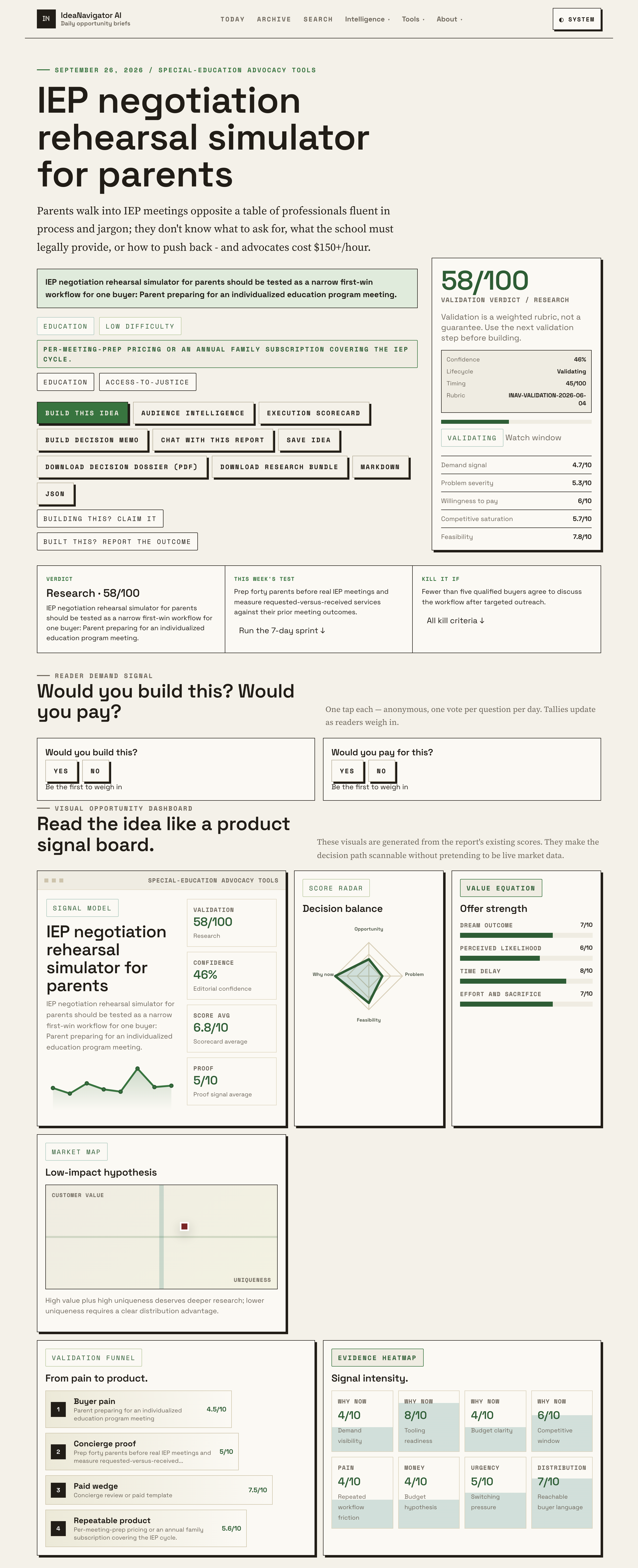
A product concept published by IdeaNavigator AI proposes an AI-powered simulator that lets parents rehearse individualized education program (IEP) meetings at home, including realistic pushback from a simulated school team. The concept is unvalidated; its proposed test would measure whether rehearsed parents win more services than in prior meetings.
A newly published product concept from IdeaNavigator AI proposes an at-home IEP negotiation rehearsal simulator that would let parents practice individualized education program meetings against an AI playing the role of the school team — including realistic pushback — before they sit down for the real thing. The concept targets a single buyer: a parent preparing for an IEP meeting who currently faces a table of professionals fluent in process and jargon, often without an advocate at their side.
The concept identifies a specific problem: parents frequently enter IEP meetings not knowing what to ask for, what the school is legally required to provide, or how to respond when a district team declines a request. Professional advocates who fill that gap typically charge $150 or more per hour, according to the concept document, putting sustained expert help out of reach for many families.
The proposed minimum viable product works in three steps. A parent uploads their child’s current IEP and evaluation reports. The tool then explains the family’s entitlements in plain language and generates a request list with legal grounding. Finally, it role-plays the meeting itself, with the AI simulating district-side resistance, repeating the exercise until the parent can hold their positions under pressure.
The concept frames the timing around two converging trends: large language model role-play has become realistic enough to simulate an adversarial meeting, and special-education identification rates keep climbing while district resources tighten — a combination the concept says is making IEP meetings more adversarial. Monetization would follow either per-meeting-prep pricing or an annual family subscription covering the full IEP cycle.
Why Rehearsal Could Shift IEP Outcomes
IEP meetings determine the services, accommodations, and placement a child with a disability receives — speech therapy hours, classroom supports, one-on-one aides — and those decisions are made in a single sitting where parents hold legal rights but often lack the vocabulary and process fluency of the district staff across the table. A rehearsal tool that generates legally grounded request lists and drills parents against simulated pushback could narrow that information gap before the meeting rather than after.
The stakes are also financial. At $150+ per hour for a human advocate, according to the concept, a subscription product priced for families could make meeting preparation dramatically cheaper than hiring professional representation. If the validation plan holds up — better requested-versus-received service outcomes for rehearsed parents — the model could extend to other high-stakes, jargon-heavy negotiations such as 504 plans or due-process disputes.
The Gap Between Parent Rights and Practice
Under U.S. special-education law, parents are entitled to participate as equal members of the IEP team, to bring assessments, and to dispute decisions through mediation or due process. In practice, families report feeling outnumbered: meetings often include several district staff — teachers, psychologists, administrators — while the parent attends alone. Hiring an advocate or special-education attorney is the conventional workaround, and hourly rates for advocates are commonly cited at $150 or more, the figure the IdeaNavigator AI concept uses.
The concept sits in the emerging category of special-education advocacy tools and is part of a broader wave of LLM-based role-play products — interview preparation, negotiation coaching, and difficult-conversation practice — that became viable as conversational models improved. It is a concept document, not a shipping product: no named team, funding, or launch date is attached.
What the Concept Hasn’t Proven Yet
The simulator is unbuilt and unvalidated. The concept document describes what an MVP should do, not what a working product does today, and no development team, funding, or release timeline has been announced.
Several substantive questions remain open. The accuracy of the tool’s plain-language entitlement explanations and its legal grounding has not been tested, and errors in either could lead parents to request services the district is not obligated to provide — or miss ones it is. It is unclear how the tool would handle state-by-state variation in special-education law, how it would protect the sensitive student records uploaded to it, and whether AI role-play pressure resembles real district pushback closely enough to change meeting behavior. The proposed forty-parent study has not been conducted, so there is no evidence yet that rehearsal improves requested-versus-received outcomes.
Validation Plan and Open Questions
The concept’s stated next step is a validation study: preparing forty parents before their real IEP meetings and comparing the services they receive against what they requested and against their own prior meeting outcomes. A result showing rehearsed parents closing the gap between requested and received services would be the signal to build beyond the MVP.
For now, the item exists as a concept in the special-education advocacy tools category. Parents seeking meeting help today still rely on published parent rights guides, free parent training centers, and paid advocates. Whether the simulator becomes a product — and whether an operator picks it up — has not been announced.
Source: IdeaNavigator AI
Key Questions
Is the IEP meeting simulator an actual product I can use today?
No. It is a published product concept from IdeaNavigator AI describing what an MVP should do. No working tool, launch date, or company has been announced.
How would the simulator work if it is built?
Per the concept, a parent uploads the current IEP and evaluation reports, the tool explains entitlements in plain language and generates a legally grounded request list, and then role-plays the meeting with realistic district pushback until the parent can hold their positions.
How much would it cost?
The concept proposes either per-meeting-prep pricing or an annual family subscription covering the IEP cycle. No prices are set. For comparison, it cites human advocates at $150 or more per hour.
Could an AI give parents wrong legal advice about special education?
That risk is real and unaddressed. The tool’s legal accuracy has not been tested, special-education rules vary by state, and no validation study has been run. Parents facing disputes should still consult qualified advocates or attorneys.
How would anyone know the simulator actually helps?
The concept’s proposed test is to prep forty parents before real IEP meetings and measure requested-versus-received services against their prior meeting outcomes. That study has not been conducted.
Source: IdeaNavigator AI
Fall Picks
fall essentials
As an affiliate, we earn on qualifying purchases.