
📊 Full opportunity report: The Changing Landscape Of AI: From Frontier Labs To Data Center REITs on IdeaNavigator AI — validation score, market gap, and execution plan.
TL;DR
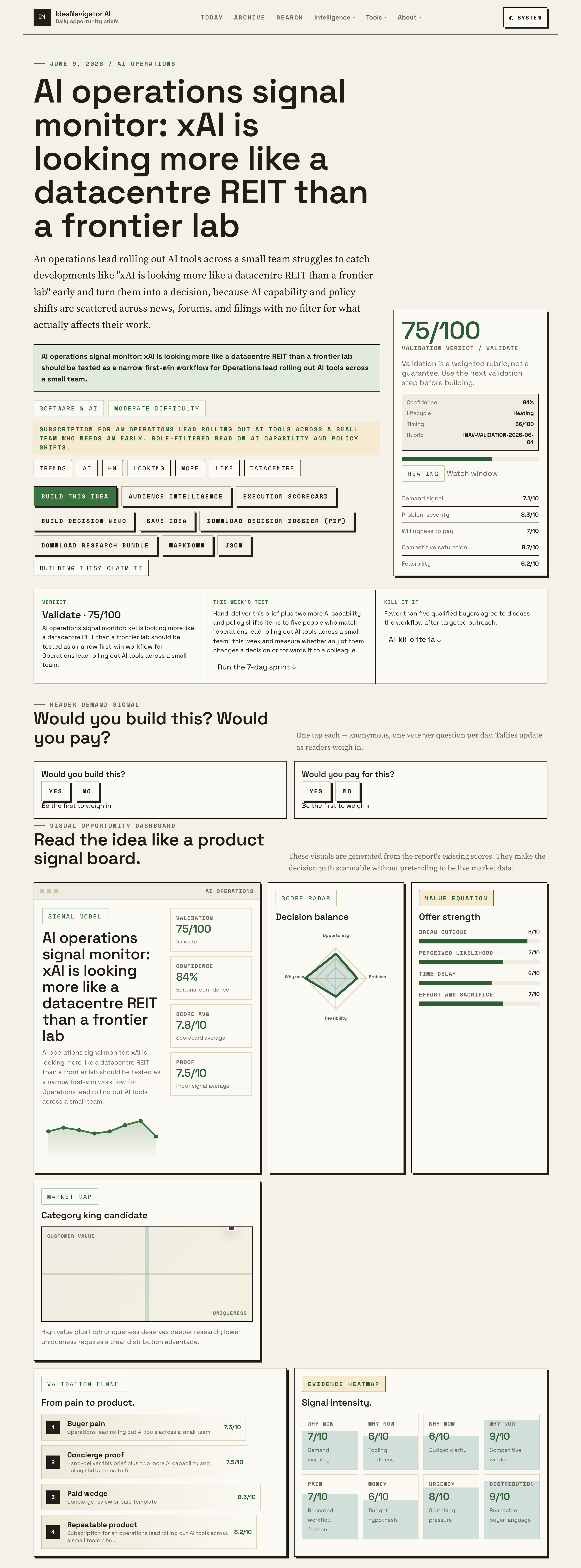
AI companies are increasingly resembling data center REITs rather than traditional research labs. This shift reflects a focus on infrastructure and operational scale, impacting industry investment and strategy.
Recent industry signals reveal that AI companies such as xAI are increasingly adopting operational models akin to data center REITs, marking a significant shift from traditional frontier research labs. This development matters because it could reshape investment patterns, infrastructure requirements, and strategic priorities within the AI sector.
Industry sources and recent reports indicate that AI firms are moving away from the experimental, innovation-focused model of frontier labs toward infrastructure-centric operations resembling data center REITs. This trend was highlighted by a signal observed on Hacker News, where discussions pointed to xAI’s evolving focus on scalable, infrastructure-like deployment rather than pioneering research.
Analysts note that this shift reflects broader industry dynamics, emphasizing operational efficiency, cost management, and scalability. Unlike traditional research labs, which prioritize innovation and experimentation, these new models prioritize the deployment and maintenance of large-scale AI infrastructure, often requiring significant capital investment and operational expertise.
Experts caution that while this trend is gaining momentum, it remains in early stages, with many companies still balancing research ambitions against infrastructure demands. The trend’s implications could influence investor interest, potentially favoring infrastructure-focused entities over pure research startups.
Implications for Industry Investment and Infrastructure
This shift toward infrastructure-like AI operations could significantly influence how investors allocate capital, favoring entities with scalable, operational models over traditional research-focused startups. It also suggests a potential consolidation of AI infrastructure assets, impacting funding, valuation, and competitive dynamics within the sector.
As an affiliate, we earn on qualifying purchases.
Evolution of AI Company Models and Industry Signals
Historically, AI development has centered on frontier labs and research institutions pioneering new algorithms and models. However, recent industry signals—such as discussions on Hacker News and filings from prominent AI firms—indicate a move toward operational models that resemble data center REITs. This trend aligns with the broader industry push for scalable, reliable, and cost-efficient AI deployment infrastructure, driven by the increasing demand for AI services across various sectors.
Over the past year, several industry insiders have observed a growing emphasis on infrastructure investments, with some companies explicitly framing their growth strategies around operational scale rather than research breakthroughs. This shift reflects the maturation of AI as a commercial industry, where infrastructure and deployment capabilities are critical for competitive advantage.
“The signals suggest a strategic pivot, with companies prioritizing deployment scale and infrastructure over pure research at this stage.”
— an anonymous researcher

Data Center Cooling Engineering: Data Center Cooling Engineering
As an affiliate, we earn on qualifying purchases.
As an affiliate, we earn on qualifying purchases.
Unclear Scope and Future of Infrastructure-Like AI Models
It is not yet clear how widespread this shift will become across the entire AI industry or whether it will lead to a fundamental transformation in company structures. The long-term implications for innovation, startup funding, and industry competition remain uncertain, as many firms are still balancing research ambitions with infrastructure needs.
As an affiliate, we earn on qualifying purchases.
Monitoring Industry Movements and Investment Trends
Industry observers will continue to track filings, investment patterns, and strategic announcements to assess how deeply this infrastructure shift penetrates the AI sector. Key milestones include potential mergers, new infrastructure-focused funding rounds, and strategic pivots announced by major players.
Further analysis will also examine the impact on startup ecosystems, venture capital allocations, and the evolution of AI deployment strategies in different sectors.
AI data center networking equipment
As an affiliate, we earn on qualifying purchases.
As an affiliate, we earn on qualifying purchases.
Key Questions
Why are AI companies shifting towards infrastructure-like models?
They aim to scale AI deployment efficiently, reduce costs, and meet increasing demand for AI services, which requires large-scale, reliable infrastructure.
What does this mean for AI research startups?
Research startups may face increased competition for resources and investment, as infrastructure-focused firms attract more capital and strategic interest.
Will this trend affect AI innovation?
While the focus shifts toward deployment infrastructure, innovation may become more concentrated in specialized research entities, but overall industry growth could be impacted.
How soon will this shift become mainstream?
It remains uncertain; industry signals suggest early stages, with broader adoption depending on strategic investments and market demand.
What are the risks of this infrastructure shift?
Potential risks include reduced innovation diversity, increased capital requirements, and possible market consolidation that could limit competition.
Source: IdeaNavigator AI



![GPT-5.6 Sol Ultra produces proof of the Cycle Double Cover Conjecture [pdf]](https://micronomicon.com/wp-content/uploads/2026/07/gpt-5-6-sol-ultra-produces-proof-of-the-cycle-double-cover-conjecture-pdf-featured-560x300.jpg)