🔍 Read the full analysis: What AI Automation Tools Are Small Businesses Exploring In 2027? on ThorstenMeyerAI.com

Prime made for students and young adults
- Fast, free delivery for dorm and study essentials
- Prime Video and Amazon Music included
- Member-only deals
TL;DR
A roundup from ThorstenMeyerAI.com compares 15 books that small-business owners may use to learn about AI automation. The titles cover broad business workflows, no-code approaches and ChatGPT, but they are learning resources—not automation platforms—and the available information does not establish their contents, software compatibility or results.
ThorstenMeyerAI.com has compared 15 books about AI automation for small businesses, naming a broad, multi-department guide as its best overall pick while also highlighting books focused on no-code workflows and ChatGPT, as detailed in the original analysis. The roundup evaluates the titles as learning resources, not software: owners would still need to select and configure the tools that run any workflow, such as those discussed in this guide to AI automation tools.
The site’s top choice is AI Automation for Small Businesses: A Practical Guide to Automating Marketing, Sales, Customer Service, Operations, and Everyday Work. Its title signals coverage across several common business functions. The roundup says this breadth may suit owners who want to explore more than one department, but it does not establish what specific tools, integrations or implementation instructions the book contains.
Two alternatives are framed around more specific learning paths. AI Automation Made Simple for Small Business is described as focusing on no-code workflows, while ChatGPT for Business: The 10X Playbook emphasizes workflow ideas readers can adapt. The source characterizes the choice as a tradeoff between broad coverage and a more guided or tool-focused starting point; it does not verify the books’ detailed contents from the titles alone, a distinction also relevant when comparing AI automation software for small businesses.
The other 12 titles are not named in the supplied material, so a complete list of 15 cannot be independently presented here. The roundup says its assessments rely on titles, stated audiences and promised formats, and gives more weight to practical workflow coverage, a clear entry point for nontechnical owners, and relevance to marketing, sales, customer service and operations. It does not report testing the books or the software workflows they may describe.
The 15 picks
- 1
 Smart AI for Small Business: 50 Simple Hacks to Grow Revenue, Cut Costs, and…View on Amazon →
- 2
 The Small Business Owner’s AI Handbook: How to Use Artificial Intelligence to…View on Amazon →
- 3
 AI Tools for Small Business: A Practical Guide to Automation, Saving Time, an…View on Amazon →
- 4
 AI-Powered Automation and Workflows for Small Business OwnersView on Amazon →
- 5
 ChatGPT for Business: The 10X Playbook — 100 AI Workflows to Save Time, Grow…View on Amazon →
- 6
 AI Automation for Small Businesses: Build Smarter Workflows, Save Time, Reduc…View on Amazon →
- 7
 Claude AI Made Practical: A Beginner’s Guide to Everyday Work, Small-Business…View on Amazon →
- 8
 AI Automation for Small Businesses: A Practical Guide to Save Time, Work Smar…View on Amazon →
- 9
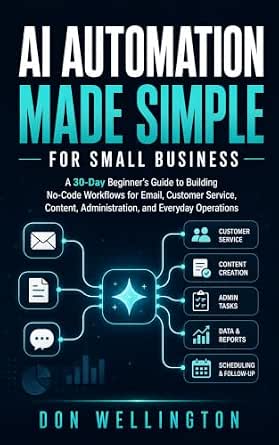 AI Automation Made Simple for Small Business: A 30-Day Beginner’s Guide to No…View on Amazon →
- 10
 AI Automation for Small Business: Simple AI Workflows for Everyday TasksView on Amazon →
- 11
 AI Automation for Small Business: A Practical Guide to Automating Marketing,…View on Amazon →
- 12
 AI for Small Business, Volume I: Getting Started — Set It Up Yourself, No Tec…View on Amazon →
- 13
 AI for Small Business: From Marketing and Sales to HR and OperationsView on Amazon →
- 14
 AI Automation for Small Businesses: Build Semi-Passive Income Systems Without…View on Amazon →
- 15
 AI for Entrepreneurs and Small Business Owners: How to Compete with Larger Bu…View on Amazon →
Choosing a Useful Starting Point
For a small business with limited time and technical support, choosing a learning resource that matches a real process can shape whether an automation experiment gets implemented. A broad guide may help an owner survey several functions; a no-code or ChatGPT-focused title may offer a narrower way to begin. Those are signals of intended scope, not proof that one book will work better for a particular business.
The practical decision comes after the reading choice. Owners need to map the repetitive task, check whether their existing email, customer database and other software can support the workflow, and decide where a person must review outputs. Customer-facing messages and sensitive records can carry risks if generated material is sent or saved without oversight. The source recommends treating setup and review as part of the work, not assuming automation eliminates it.
Popular right now

Roborock F25 XT Cordless Wet-Dry Vacuum Mop

Apple AirPods Pro (2nd Generation) Wireless Earbuds with USB-C MagSafe Charging Case

Roborock Q7 L5 Robot Vacuum and Mop Combo, 8,000 Pa Suction
As an affiliate, we earn on qualifying purchases.
What the 15-Book Comparison Measures
The roundup addresses a common distinction in AI purchasing: advice about automation is not the same thing as an automation product. The books may explain concepts, suggest workflows or offer a structured learning path, but the supplied source says buyers still have to choose and configure the AI and software services that perform the tasks.
Its comparison method is limited. According to ThorstenMeyerAI.com, it used the information signaled by titles, audiences and formats, rather than claims about unprovided contents. The site favors books that appear to balance hands-on application with broad business relevance, while recognizing that specialized guides may better suit a particular tool or learning style. Readers are advised to check descriptions or sample pages for examples and setup detail.
“These are learning resources, not automation platforms.”
— ThorstenMeyerAI.com
What the Book Titles Cannot Confirm
The supplied material does not provide the full list of 15 titles, publication dates, sample pages or detailed descriptions. It therefore cannot confirm the books’ actual instructions, supported AI services, software integrations, update schedules or costs. Titles that promise a beginner plan, no-code setup or a particular number of workflow ideas do not by themselves verify how detailed or useful that material is.
The source also provides no independent testing, business case studies or measured outcomes. It does not show whether readers can implement the suggested workflows with their current software, how much time any automation might save, or how often human review would be needed. Those questions depend on each business’s systems, process and risk tolerance.
Check Fit Before Buying
Owners considering a guide can begin by identifying a frequent, repetitive task and writing down its current steps, who handles it and what a successful result looks like. They can then compare that need with a book’s description and sample pages, and verify that any proposed workflow fits their existing software. For higher-risk or customer-facing tasks, businesses should decide in advance which outputs require human approval.
The roundup gives no scheduled follow-up or forthcoming milestone. A stronger assessment would require the complete list, access to the books’ contents and evidence from implementation in real business settings. Until then, the comparison is best read as a shortlist of possible learning paths, not a verdict on which AI tools or workflows will deliver results in 2027.
Key Questions
Are the 15 picks AI automation software?
No. ThorstenMeyerAI.com describes them as books and learning resources. Businesses still need to choose and configure software to run workflows.
Which book does the roundup rank highest?
It names AI Automation for Small Businesses: A Practical Guide to Automating Marketing, Sales, Customer Service, Operations, and Everyday Work as its best overall pick, based on the broad scope signaled by its title.
What are the more focused alternatives?
AI Automation Made Simple for Small Business is presented as a no-code-oriented guide, while ChatGPT for Business: The 10X Playbook is described as offering workflow ideas to adapt. The supplied information does not verify their detailed contents.
Does the comparison prove these books save time or money?
No. The source provides no measured results or independent testing. Outcomes would depend on a business’s processes, software and implementation.
Source: ThorstenMeyerAI.com