
TL;DR

Prime made for students and young adults
- Fast, free delivery for dorm and study essentials
- Prime Video and Amazon Music included
- Member-only deals
NASA says four volunteers in its CHAPEA Mission 2 simulation are scheduled to exit their Johnson Space Center habitat on Oct. 31, after 378 days in isolation. The agency says mission data may inform planning for Artemis and future lunar missions, including crew health, food systems, schedules and communications.
Four volunteers who spent 378 days in isolation inside a simulated Mars habitat at NASA’s Johnson Space Center in Houston are scheduled to exit on Saturday, Oct. 31, the agency said. NASA plans live coverage of the departure, which marks the end of the second Crew Health and Performance Exploration Analog (CHAPEA) mission and provides data the agency says can inform preparations for future lunar and deep-space missions.
The four crew members are Ross Elder, Ellen Ellis, James Spicer and Matthew Montgomery. NASA said the exit ceremony will begin at 3 p.m. EDT and will be streamed on NASA Johnson’s YouTube channel and social media accounts. Johnson Space Center Director Vanessa Wyche and NASA astronaut Jack Hathaway are scheduled to give remarks, as are the four participants.
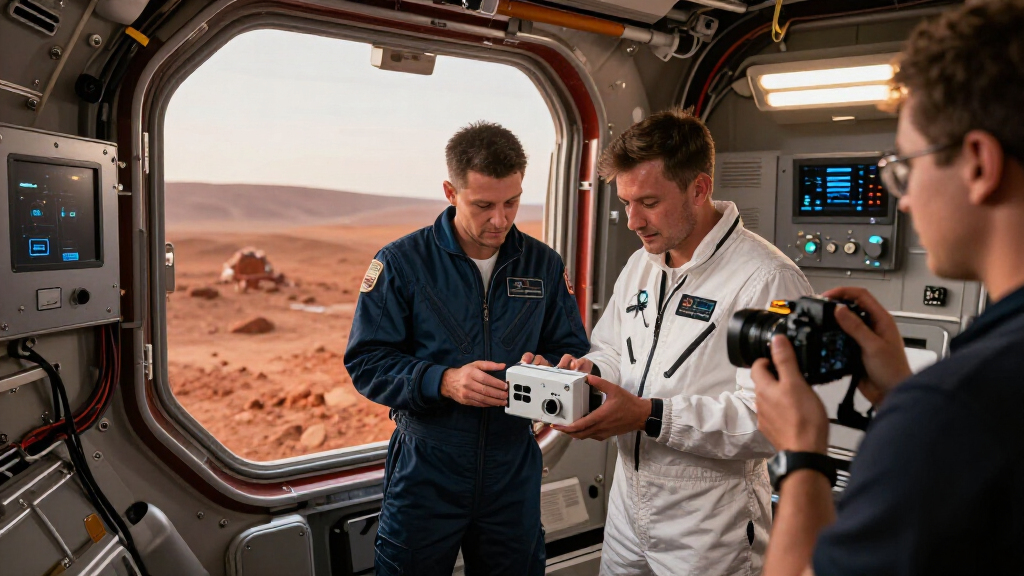
The volunteers lived and worked in a 1,700-square-foot, 3D-printed habitat, carrying out activities designed to resemble aspects of a Mars mission. NASA lists simulated spacewalks, exercise, habitat maintenance and plant growing among their tasks. The crew also faced planned stressors including communication delays, limited resources and isolation.
NASA invited media to watch the ceremony at the Johnson Space Center, where a screen will be set up outside the hangar containing the habitat. The agency says reporters will be able to capture the crew’s exit from the building and speak with an available subject matter expert. U.S. media seeking in-person access, or virtual interviews with crew members in the days after the mission, were asked to contact the Johnson newsroom by 2 p.m. on Friday, Oct. 30.
How CHAPEA Data Could Inform Missions
The simulation is intended to help NASA study how people live and work under conditions that could affect future missions beyond low Earth orbit. The agency says data from CHAPEA may help it refine food-system design, crew schedules and use of communications bandwidth, including capacity on NASA’s Deep Space Network.
NASA also says the results can support flight doctors and psychologists as they develop medical care and behavioral support for crews. Those are stated research goals, not findings announced with the exit schedule: the release does not report specific results or establish that any particular approach has been validated. The practical value will depend on how NASA analyzes the collected information and applies it to mission planning.
Popular right now

Vitamix Propel Series 750 Professional-Grade Blender, 4 Programs, Black

Ninja SP151 Flip Toaster Oven and Air Fryer, 8-in-1, Stainless Steel

Ninja Foodi 10-Quart DualZone 6-in-1 Air Fryer, Black, DZ302
As an affiliate, we earn on qualifying purchases.
A Second Yearlong CHAPEA Mission
CHAPEA is a NASA analog program that uses a ground-based habitat to study crew health and performance in conditions modeled on a long-duration Mars mission. Unlike an actual mission, the participants remain on Earth, but the facility and planned operational pressures are intended to reproduce selected constraints of living in a remote environment.
NASA’s release says Mission 2 began on Oct. 19, 2025, and describes the crew’s stay as 378 days. It connects the study’s potential applications not only to Mars planning but also to Artemis and future Moon Base missions. The agency has not described the simulation as a Mars flight or as a direct test of every condition a crew would encounter in space.
Mission Findings Still Await Analysis
NASA’s announcement focuses on the crew’s scheduled exit and media arrangements. It does not provide specific research findings, explain how the data will be analyzed, or give a timeline for publishing results. The agency says the information can help future mission planning, but the release does not quantify expected effects or say which recommendations will follow from this mission.
The announcement also does not specify the year for the stated Saturday, Oct. 31 exit date. It identifies Mission 2’s start as Oct. 19, 2025, and describes the stay as 378 days, but those details do not align clearly with the listed exit date. NASA’s announced ceremony time and date should therefore be treated as the schedule in its release; readers should check NASA Johnson’s channels for any clarification or change.
Crew Exit and Post-Mission Interviews
NASA plans to stream the crew’s departure at 3 p.m. EDT on Oct. 31, with remarks from NASA officials and the participants. The agency has also offered media interviews with the crew in the days after the mission, subject to arrangements through the Johnson Space Center newsroom.
After the exit, the next substantive step will be NASA’s assessment of the collected health and performance information. The agency has not announced when results or a fuller account of the mission’s findings will be released. Updates to the schedule and subsequent research details remain subject to NASA announcements.
Key Questions
Who is leaving the CHAPEA habitat?
Ross Elder, Ellen Ellis, James Spicer and Matthew Montgomery are the four volunteers scheduled to exit after the simulated mission.
When can the public watch the crew exit?
NASA says live coverage is scheduled for 3 p.m. EDT on Saturday, Oct. 31, on NASA Johnson’s YouTube channel and social accounts. The release does not specify the year for that date.
Was this an actual Mars mission?
No. CHAPEA is an Earth-based simulation in a habitat at NASA’s Johnson Space Center. The crew performed activities and faced constraints intended to model selected aspects of a long-duration mission.
What does NASA expect to learn from the mission?
NASA says the data may help with food systems, crew time, communications, medical care and behavioral support for future missions. The agency has not yet announced specific findings from Mission 2.
Source: nasa.gov