
🔍 Read the full analysis: The Clockwork Rhythm Of “Nightmarket — Mercado De Medianoche”’s Closing Scene on ThorstenMeyerAI.com

Prime made for students and young adults
- Fast, free delivery for dorm and study essentials
- Prime Video and Amazon Music included
- Member-only deals
TL;DR
ThorstenMeyerAI.com describes “Nightmarket — Mercado de Medianoche,” a live digital market whose closing scene changes gradually as its stalls wind down. The guide presents clock-driven atmosphere as a design approach, but does not specify the implementation, schedule or technical measurements behind the room.
ThorstenMeyerAI.com has published a field guide to Nightmarket, a live digital market whose closing scene unfolds through gradual, clock-driven visual changes. The design turns the room’s shift from a busy market to a nearly empty one into the main event, offering a case study in using time—not just a static image—to shape a digital environment.
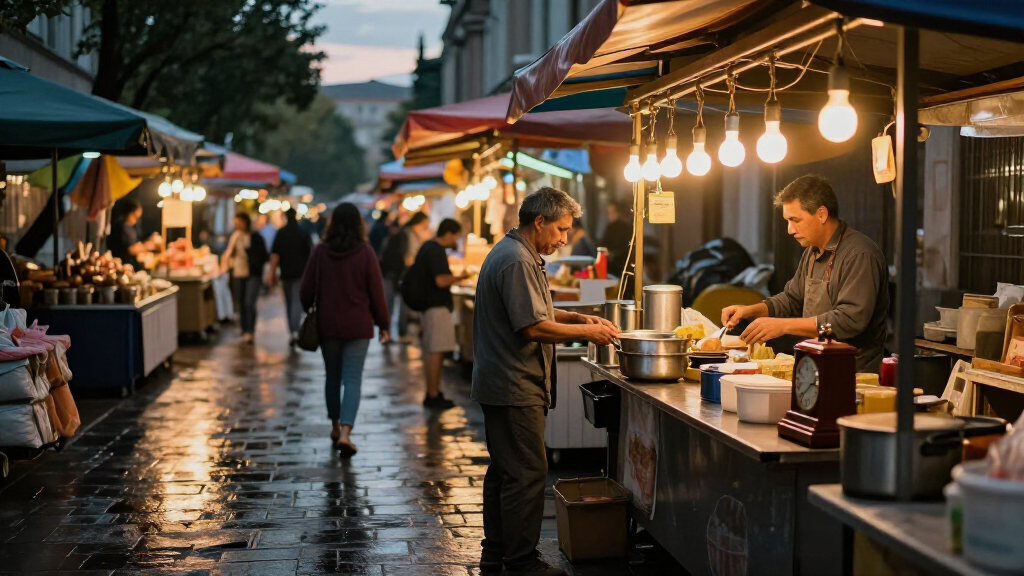
The guide describes a scene built from lantern-like warmth, imperfect neon and rising steam, with the atmosphere changing as the market winds down. Rather than showing a single finished view, the room is presented as a sequence: details accumulate, stalls begin to disappear, and activity gives way to a quieter setting. The material describes this as an approach to making a digital market feel lived-in, rather than like a polished backdrop.
Its central design idea is to treat time as a mechanism for changing the room. Small shifts are intended to add up to a larger impression of closing. The guide says it follows how the effects are built and how they work together, but it does not name specific software, code, automation systems or timing intervals. It also does not report user tests or measurements of how viewers respond.
The page points readers to a full design teardown and a live room. Those links frame the piece as both a presentation of a digital environment and a practical design guide. The available description, however, does not establish how long the closing sequence lasts, whether it runs on a fixed schedule or whether viewers can change its behavior.
FIELD GUIDE / DIGITAL ENVIRONMENTS
The Clockwork Rhythm Of “Nightmarket — Mercado De Medianoche”’s Closing Scene
A live digital market turns closing time into its main event. As stalls wind down, gradual visual shifts move the room from busy to nearly empty—and make time part of the atmosphere.
What if the most convincing way to make a digital market feel alive were to give it a closing time?
ThorstenMeyerAI.com01 / ATMOSPHERE
A market that winds down in layers
The guide presents a sequence of small changes that accumulate into a larger impression: a place moving toward its end of day.
Lantern-like light
Warm illumination gives the market an inviting, lived-in starting point before the scene grows quieter.
Imperfect neon
Uneven neon adds a handmade edge to the environment, keeping it from feeling like a polished backdrop.
Rising steam
Steam supplies a subtle sense of activity while the market is still in motion.
02 / CLOSING SEQUENCE
Small shifts build a clear ending
The description frames the room as a progression, not a single finished view. This sequence summarizes the stated visual arc, not a confirmed schedule.
Market in motion
Warm light, neon and steam establish the scene.
Details accumulate
Atmospheric cues make the room feel active and inhabited.
Stalls recede
Visible activity reduces as stalls begin to disappear.
Quiet remains
The market approaches a nearly empty closing scene.
“Instead of treating atmosphere as a static visual layer, the room uses time as a design mechanism.” — ThorstenMeyerAI.com
03 / WHAT THE DESCRIPTION ESTABLISHES
Creative proposition, not measured outcome
Clock-driven atmosphere may help a room communicate changing activity through visual cues. The available description does not test that proposition.
Conceptual illustration of the described arc only. Bar lengths do not represent measured activity, elapsed time or technical data.
04 / DETAILS NOT PROVIDED
The rhythm is visible; its mechanics are not
The guide describes the intended progression but leaves key implementation and evaluation questions open.
No sequence length, interval or closing schedule is stated.
It is unclear whether changes follow a fixed schedule, real time or another trigger.
The description does not say whether visitors can change the behavior.
No software, code or automation system is named in the available material.
No user research, accessibility assessment or performance data is reported.
The description does not establish what technical detail the teardown includes.
05 / KEY QUESTIONS
What readers can take away
The field guide is a creative example of clock-driven storytelling in a digital environment.
What is “Nightmarket — Mercado de Medianoche”?
A live digital market described as a scene that changes gradually as it approaches closing time.
What happens in the closing scene?
Small visual changes accumulate as the market moves from busy to nearly empty, with stalls beginning to disappear.
How does the room create its atmosphere?
The description highlights warm, lantern-like light, imperfect neon and rising steam, alongside time-driven changes.
Can visitors control the timing?
That is not specified. The available description does not say whether the sequence is fixed, real time or visitor-controlled.
Where can readers learn more?
ThorstenMeyerAI.com points readers to a full design teardown and a live room.
What is the clearest conclusion?
Nightmarket uses a gradual closing scene to explore time as a visual design tool; the description does not establish measured benefits.
Time Shapes the Market’s Exit
The design approach matters to people building generative environments and responsive interfaces because it treats atmosphere as something that develops, rather than a layer placed over a finished scene. A room that changes over time can communicate a shift in activity through visual cues, without relying only on a status label or message. In this example, the cues described are the gradual disappearance of stalls and the change from busy to nearly gone.
That is a design proposition, not evidence of a measured benefit. The guide does not provide comparisons with static scenes, accessibility assessments, user feedback or performance data. Its value for readers is therefore as a specific creative example of clock-driven storytelling, rather than a validated claim that this method improves interfaces or makes a digital space more convincing for every viewer.
As an affiliate, we earn on qualifying purchases.
A Digital Market With Closing Time
The field guide’s framing question is how to make a digital market feel alive. Its answer is to give the room a closing time, then let its visible details change as that time approaches. Warm light, neon and steam establish the setting; the gradual reduction in activity supplies the sense of a scene moving toward an end.
The concept connects an atmospheric environment with automation and generative design, subjects of interest to the site’s readers. But the description does not provide a publication date, a technical walkthrough in the material presented here, or a timeline of earlier versions. The confirmed development is the availability of the field guide and live-room link, not a broader product launch or independently documented technical release.
“What if the most convincing way to make a digital market feel alive were to give it a closing time?”
— ThorstenMeyerAI.com
interactive digital scene automation software
As an affiliate, we earn on qualifying purchases.
As an affiliate, we earn on qualifying purchases.
How the Closing Sequence Runs
The available description does not say what triggers the changes, how often they occur or how long the sequence takes. It also does not detail the code, tools or automation behind the effects, or clarify whether the live room changes in real time for every visitor.
There is no reported audience research, technical benchmark or evidence that the method produces a particular result across different devices. The guide’s description establishes the intended visual progression, but the degree to which the scene’s changes are interactive, scheduled or fixed remains unclear.
ambient lighting for digital environments
As an affiliate, we earn on qualifying purchases.
As an affiliate, we earn on qualifying purchases.
The Teardown and Live Room
Readers can follow the page’s links to the full design teardown and visit the live room. Those are the next available steps for seeing the scene and learning more about its construction. The material does not announce a release date for further details, a new version or additional technical documentation.
Whether the teardown answers questions about timing, implementation and viewer control is not established in the available description. Until those details are provided, the clearest account is that Nightmarket uses a gradual closing scene to explore time as a visual design tool.
Source: ThorstenMeyerAI.com
As an affiliate, we earn on qualifying purchases.
Key Questions
What is “Nightmarket — Mercado de Medianoche”?
It is a live digital market described by ThorstenMeyerAI.com as a scene that changes gradually as it approaches closing time.
What happens in the closing scene?
The guide describes small visual changes accumulating as the market moves from busy to nearly empty, with stalls beginning to disappear.
How does the room create its atmosphere?
The description highlights warm, lantern-like light, imperfect neon and rising steam, combined with changes driven by time. It does not specify the underlying software or code.
Can visitors control the timing or changes?
The available description does not say whether visitors can control the sequence, or whether it follows a fixed or real-time schedule.
Where can readers learn more?
ThorstenMeyerAI.com links to a full design teardown and a live room. The description does not specify what technical details the teardown includes.
Source: ThorstenMeyerAI.com
Halloween Picks
halloween
As an affiliate, we earn on qualifying purchases.