Every room, tool, and household system is shaped by science. Airflow determines whether humidity spreads evenly. Ergonomics affects how a computer user’s wrist and shoulder respond to long work sessions. Water pressure, drainage, ultraviolet exposure, battery design, and mechanical leverage all influence whether equipment is suitable for a particular setting. Understanding these principles makes it easier to evaluate products without relying only on marketing language.
This hub is an orientation guide to the practical science behind indoor comfort, water management, cleaning equipment, ergonomic workspaces, and specialized tools. It is designed to help homeowners, facility managers, tradespeople, and curious readers identify the variables that matter, ask better questions, and find the right deep-dive guide for their needs.
How to Evaluate Technical Products
A technical product should be judged as part of a system rather than as an isolated object. A humidifier interacts with room volume, ventilation, ambient humidity, and water quality. A sump pump depends on basin dimensions, discharge plumbing, electrical availability, and incoming water volume. Even a cordless vacuum must be considered in relation to flooring, storage space, cleaning habits, and the user’s ability to handle its weight.
Begin by defining the problem in measurable terms. Instead of looking for a “powerful” appliance, identify the area it must serve, the material it must handle, the frequency of use, and the conditions under which it will operate. Useful specifications can include flow rate, runtime, reservoir capacity, operating range, dimensions, compatible materials, or required power supply. The relevant measurements change by category, but the principle remains consistent: match capacity to the actual task.
Next, distinguish between primary performance and supporting features. A self-standing vacuum may be easier to pause and store, but it must still clean the intended surfaces. A backup sump pump offers resilience, but the complete installation must still move water away from the building effectively. Convenience features matter most after the core technical requirements have been satisfied.
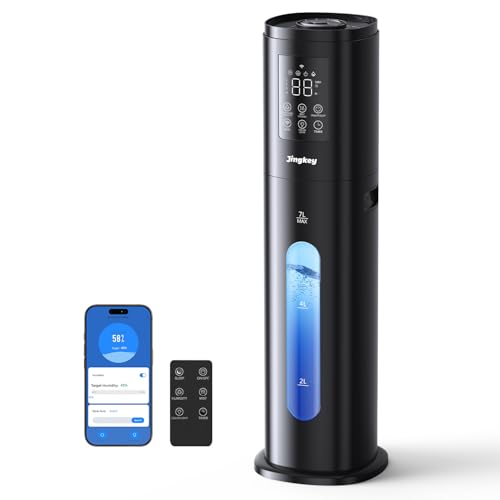
Humidifiers for Bedroom Large Room Humidifiers for Home,7L/1.85Gal Large Humidifier with Smart App & Remote Control, 4 Mist Levels Cool Mist Humidifiers Black
- Large Capacity: 7L water tank for 60 hours use
- High Moisture Output: 350mL/h for up to 500 sq.ft
- Multiple Mist Levels: 4 adjustable mist settings
As an affiliate, we earn on qualifying purchases.
As an affiliate, we earn on qualifying purchases.
Indoor Air, Humidity, and Environmental Comfort
Indoor comfort is affected by temperature, relative humidity, air movement, particles, and ventilation. These factors interact. Warm air can contain more water vapor than cool air, so the same quantity of moisture can produce different relative-humidity readings as temperature changes. That is one reason a room may feel dry during the heating season even when no obvious source of dryness is present.
Understanding Humidifier Coverage
Humidifier coverage figures are best treated as starting points rather than guarantees. Room size matters, but ceiling height, door position, drafts, insulation, heating systems, and the starting humidity level can all change performance. A large open room may require a different strategy from a closed bedroom with the same floor area.
Ultrasonic humidifiers use high-frequency vibration to create a fine mist. They can deliver moisture without boiling water, but operation and maintenance deserve attention. Minerals present in the water may be dispersed with the mist, while standing water and neglected internal surfaces can create hygiene concerns. Water choice, cleaning access, tank design, output control, and humidity monitoring are therefore central considerations.
Readers comparing capacity, controls, and room suitability can use the guide to the best ultrasonic humidifiers for large rooms as a category-specific next step. Whichever device is chosen, a separate hygrometer can provide useful context, and moisture should not be added blindly. Condensation on windows or persistent dampness can indicate that output is excessive for the conditions.
Think in Terms of the Whole Room
A single appliance cannot compensate for every environmental problem. Persistent dryness may be related to air leakage or heating patterns, while persistent dampness may point to ventilation, drainage, or building-envelope issues. Observe when and where a problem occurs. Record humidity at different times, note whether doors are open, and consider whether the issue changes with outdoor weather. Simple observations often reveal more than a headline specification.

Gimars Upgrade Enlarge Silky and Superfine Fabric Gel Memory Foam Keyboard Wrist Rest Set, Ergonomic Keyboard Mouse Wrist Support for Typing Pain Relief, Comfort for Office, Gaming, Computer, Black
- Ultra Thick Memory Foam: 1.2-inch supportive, slow rebound foam
- Ergonomic Design: Elevates wrists, relieves pressure
- Durable 3-Layer Construction: Rubber base, memory foam, breathable fabric
As an affiliate, we earn on qualifying purchases.
As an affiliate, we earn on qualifying purchases.
Water Quality and Ultraviolet Treatment
Household water treatment is a sequence of processes. Sediment filtration, chemical treatment, softening, activated carbon, membrane filtration, and ultraviolet treatment address different concerns. They should not be treated as interchangeable technologies.
Ultraviolet systems expose water to UV light within a treatment chamber. Their role is not to strain out particles, remove dissolved minerals, or improve taste. Effective application depends on factors such as water clarity, flow conditions, lamp condition, sleeve cleanliness, and correct system sizing. If suspended material blocks light from reaching microorganisms, treatment conditions can be compromised.
Questions to Ask Before Choosing a UV System
- What is the peak household flow rate rather than only the average usage?
- Has the source water been tested so the underlying issue is understood?
- Does the water require pretreatment for sediment, hardness, or other conditions?
- Where can the chamber be installed with room for servicing?
- How will lamp replacement, sleeve cleaning, and other maintenance be tracked?
- What happens to the water supply during a power interruption?
A whole-house unit must be selected in the context of plumbing demand and water characteristics. The comparison of whole-house UV sterilizers can help readers explore available system configurations after those requirements are established. Water with suspected microbial or chemical contamination should be evaluated through appropriate testing and professional guidance rather than appearance, taste, or odor alone.

3/4 HP Water Pressure Booster Pump for Home Automatic Water Pump Electric 17 GPM Shallow Well Jet Pump 110v Garden Hose Pressure Booster Pump High Volume Lawn Sprinkler Water Transfer Pump
- Powerful Water Pressure: Delivers 130 ft head, 17 GPM flow
- Automatic Operation: Sensors auto-start and stop pump
- Adjustable Pressure: Fine-tune pressure with screw control
As an affiliate, we earn on qualifying purchases.
As an affiliate, we earn on qualifying purchases.
Drainage, Flood Protection, and Backup Planning
Sump systems manage water that collects below a building, commonly in a basin. The operating concept is straightforward: rising water activates a pump, which sends water through a discharge line. Reliability, however, depends on more than the pump itself. Basin capacity, switch movement, check-valve operation, discharge routing, pipe resistance, power availability, and the rate of water entry all affect the result.
Why Redundancy Matters
Heavy water intrusion can occur during storms, when utility power may also fail. A primary pump alone therefore leaves several possible failure points. Combination systems pair a primary pump with a backup arrangement, often with separate controls. The goal is resilience: if one component or power source is unavailable, another layer can respond.
Anyone planning or upgrading a system should examine the best combination sump pump systems while accounting for the building’s own drainage conditions. Capacity should be evaluated at the required lift, not merely at an idealized condition. Vertical rise and pipe friction reduce the flow a pump can deliver at the outlet.
Routine inspection is equally important. Confirm that floats move freely, inlet paths are unobstructed, and discharge water exits where it will not immediately return toward the foundation. Backup power components also have maintenance requirements. A second pump is useful only if its energy source, controls, and discharge path remain functional.

KARDV Cordless Vacuum Cleaner, 500W/40Kpa Vacuum Cleaners for Home, 60Mins Stick Vacuum with LED Display, Anti-Tangle & Wall Mount Charging, 8 in 1 Lightweight Vacuum for Hard Floors Carpet Pet Hair
- Powerful Suction: 450W motor with 40Kpa suction power
- Long Battery Life: Up to 60 minutes runtime on a single charge
- Adjustable Suction: Two-speed settings for versatile cleaning
As an affiliate, we earn on qualifying purchases.
As an affiliate, we earn on qualifying purchases.
Cleaning Equipment Through the Lens of Mechanics
Vacuum selection involves airflow, suction, floor contact, filtration, battery energy, weight distribution, and debris handling. No single number completely describes cleaning performance because the machine must move air through a changing pathway that includes the floor head, tubing, filters, and dust container.
Balance Performance with Daily Usability
A vacuum that is inconvenient to retrieve, maneuver, empty, or store may be used less often. Cordless stick models reduce dependence on nearby outlets, but runtime varies with operating mode and attachments. The stated maximum may not represent continuous use at the setting required for a particular surface.
Self-standing construction addresses a practical interruption problem: where to place the machine when moving furniture, answering a door, or pausing between rooms. Stability should still be considered on the surfaces where the vacuum will actually rest, especially around children, pets, or busy walkways. The guide to cordless stick vacuums that stand on their own focuses on models designed around this convenience.
Before comparing models, inventory the home’s surfaces and debris. Fine dust, long hair, larger crumbs, rugs, hard floors, stairs, and upholstery create different demands. Also consider where the unit will charge, whether attachments have a defined storage location, and how easily washable or replaceable components can be maintained.
Ergonomics for Computer Work
Ergonomics is not about finding one universally correct posture. It is about fitting tools and tasks to the individual, reducing unnecessary force, and allowing movement. Repetition, duration, grip pressure, wrist position, reach, and workstation height all contribute to physical load.
What a Vertical Mouse Changes
A vertical mouse rotates the hand toward a handshake-like orientation. This changes forearm position compared with a conventional flat mouse, but shape alone does not guarantee comfort. Hand size, grip style, button placement, pointer sensitivity, desk height, and the location of the keyboard all influence the experience.
Explore the guide to ergonomic vertical mice to compare formats, then assess each option within the full workstation. A mouse should be reachable without repeatedly extending the shoulder. The wrist should not be forced against a sharp desk edge, and pointer settings should allow navigation without excessive movement.
Adaptation may take time because the muscles and movement patterns used can differ from those associated with a familiar mouse. Short initial sessions can make the transition easier. Persistent pain, numbness, weakness, or tingling should not be treated simply as a product-selection problem; those symptoms may warrant guidance from a qualified health professional.
Workshop Science and Pipe Threading
Pipe threading combines cutting geometry, torque, lubrication, clamping, and material compatibility. A threading machine rotates or supports work while dies form threads at the pipe end. Accurate preparation matters because damaged, misaligned, or poorly formed threads can interfere with assembly and sealing.
Match the Machine to the Work
Start with pipe material, diameter range, thread standard, job volume, and working environment. A machine appropriate for occasional shop use may not suit repetitive production or field work. Portability, support stands, chip collection, oil handling, die availability, and access to replacement parts can be as consequential as headline motor information.
The roundup of pipe threading machines offers a focused route into the category. Before operating any machine, users should follow its manual, understand guarding and control placement, secure the work properly, and use suitable protective equipment. Rotating machinery creates entanglement hazards, so loose clothing, jewelry, hair, and gloves require particular attention according to the manufacturer’s safety instructions.
A Better Research Workflow
Good product research moves from the environment to the specification, then from the specification to the model. First, define the job and record constraints. Second, identify the performance measure connected to that job. Third, check installation, maintenance, consumables, and compatibility. Finally, compare convenience features and design preferences.
- Measure the room, pipe, basin, hand, clearance, or service area involved.
- Separate required capabilities from optional conveniences.
- Check performance under realistic operating conditions.
- Account for cleaning, replacement parts, power, and recurring maintenance.
- Read installation and safety documentation before committing to a system.
- Plan for failures where water, electricity, or rotating machinery is involved.
The strongest choice is rarely the product with the longest feature list. It is the one whose operating conditions, capacity, maintenance burden, and physical design align with the real setting. Use the linked guides for category-level comparisons, but begin with the science of the problem. That approach turns a crowded marketplace into a manageable set of engineering, health, and usability decisions.