📊 Full opportunity report: When-to-replace planner for data center equipment on IdeaNavigator AI — validation score, market gap, and execution plan.
Listen free for 30 days with Audible
Thousands of audiobooks and originals — cancel anytime.
Start your free trialAs an affiliate, we earn on qualifying purchases.
TL;DR
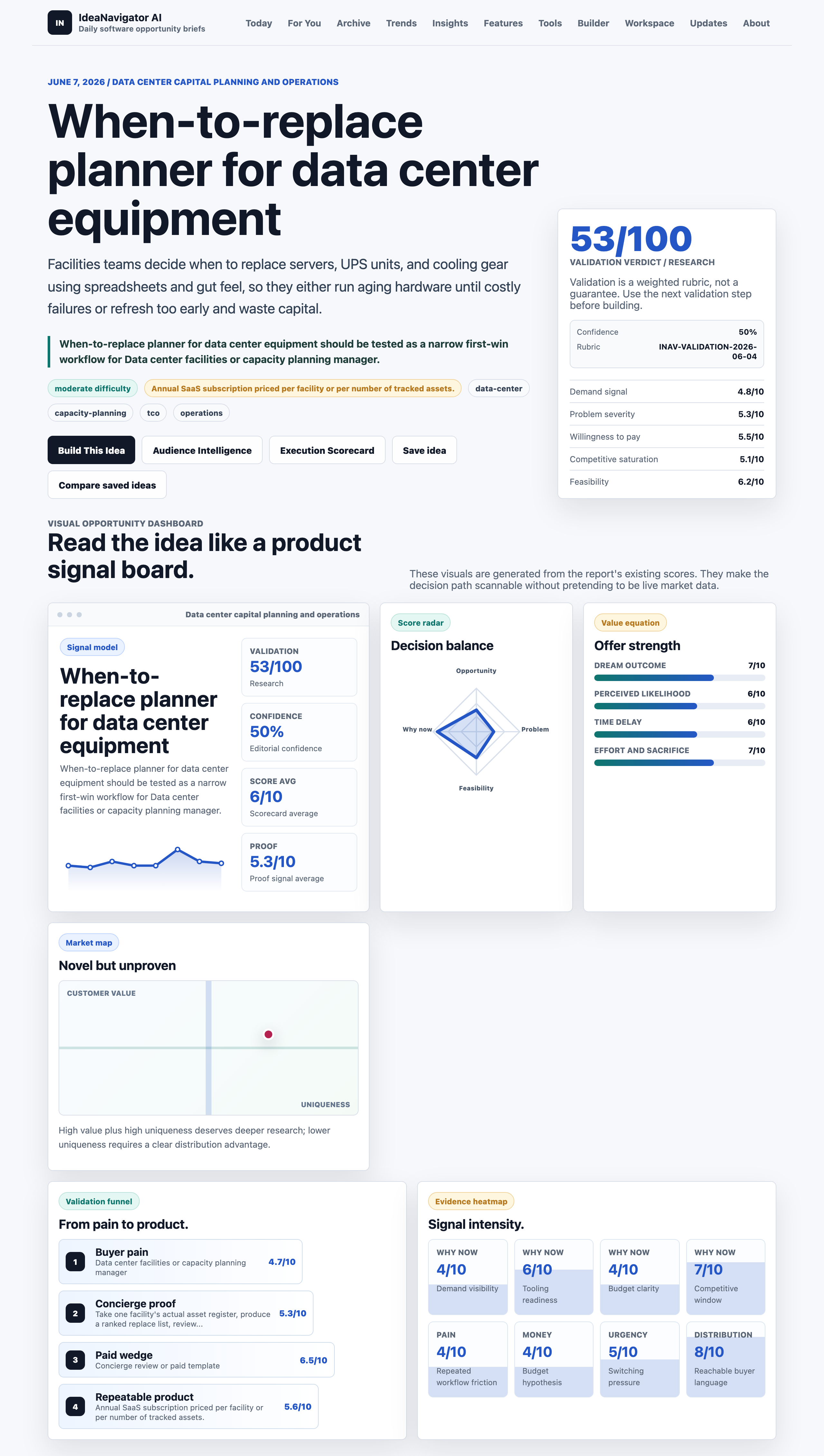
A new ‘when-to-replace’ planner for data center equipment is being tested to assist facilities managers in making data-driven decisions on hardware refreshes. The tool analyzes asset age, energy use, and failure costs to recommend optimal replacement timing, addressing a key challenge in data center operations.
A new software tool designed to guide data center facilities managers on when to replace servers, UPS units, and cooling equipment is in the testing stage, aiming to improve decision-making and reduce costs.
The proposed ‘when-to-replace’ planner ingests a facility’s asset list, including data on age, power consumption, and maintenance costs, then ranks equipment based on a calculated score for replacement versus retention. The tool considers rising energy costs and failure risks, providing a prioritized list of assets for potential replacement.
This approach aims to replace current practices, which often rely on spreadsheets and managerial intuition, with a data-driven process that can optimize hardware refresh cycles. Validation involves applying the tool to a single facility’s asset register, reviewing the ranked recommendations with the capacity manager, and measuring the level of agreement with current plans.
Why It Matters
This development matters because it addresses a critical challenge in data center operations: balancing the costs of maintaining aging hardware against the capital expenditure of replacing equipment. As energy costs rise and hardware becomes more efficient, making timely replacement decisions becomes more complex. An effective ‘when-to-replace’ planner could reduce unnecessary capital outlays and prevent costly failures, improving overall operational efficiency.
As an affiliate, we earn on qualifying purchases.
Background
Data center facilities teams traditionally decide on hardware replacement based on manual assessments, often using spreadsheets and experience-based judgment. With rising energy costs and increasing hardware density, the economic tradeoff has become sharper, prompting the need for more precise decision tools. The concept of a ‘when-to-replace’ planner has emerged as a potential solution, with initial development efforts focusing on testing its practical utility in real-world settings.
“The goal is to create a simple, effective tool that can be integrated into existing workflows and help facilities teams make better replacement decisions.”
— an anonymous researcher
uninterruptible power supply (UPS) systems
As an affiliate, we earn on qualifying purchases.
As an affiliate, we earn on qualifying purchases.
What Remains Unclear
It is not yet clear how accurately the tool’s recommendations will align with actual operational needs across different types of data centers. The effectiveness of the ranking system and its acceptance by facilities teams remain to be validated through broader testing.
data center energy monitoring tools
As an affiliate, we earn on qualifying purchases.
As an affiliate, we earn on qualifying purchases.
What’s Next
The next step involves applying the prototype to a real data center asset register, conducting validation studies, and gathering feedback from facility managers. Further development will focus on refining the scoring algorithms and expanding the tool’s capabilities to include more asset types and operational factors.
hardware maintenance and replacement software
As an affiliate, we earn on qualifying purchases.
As an affiliate, we earn on qualifying purchases.
Key Questions
How does the ‘when-to-replace’ planner determine which equipment to replace?
The planner analyzes asset age, energy consumption, maintenance costs, and failure risk to produce a ranked list of equipment for potential replacement, balancing operational costs and efficiency gains.
Will this tool replace manual decision-making entirely?
No, it is designed to support, not replace, facilities managers by providing data-driven recommendations that can be reviewed and adjusted based on operational context.
When will the tool be available for wider use?
The current phase involves testing and validation; if successful, a SaaS version could be offered commercially within the next year or two.
What are the main benefits of using this planner?
It can help reduce unnecessary capital expenditure, prevent costly hardware failures, and optimize energy efficiency by timing replacements more accurately.
Source: IdeaNavigator AI
NFL season / tailgating Picks
team gear
As an affiliate, we earn on qualifying purchases.