A blender is designed to smash and blend ingredients into smooth textures, perfect for smoothies, creamy soups, and dairy-free milks. In contrast, a food processor cuts, slices, and kneads ingredients to create chunkier or more uniform results, ideal for chopping vegetables or shredding cheese. If you want a smooth, icy texture, a blender is your best bet. Curious about how these tools stack up for different tasks? Keep exploring to find out more.

Prime made for students and young adults
- Fast, free delivery for dorm and study essentials
- Prime Video and Amazon Music included
- Member-only deals
Key Takeaways
- Blenders excel at “smash” functions like crushing ice and liquefying ingredients for smoothies and purees.
- Food processors specialize in “cut” functions such as chopping, slicing, shredding, and kneading ingredients.
- Blenders create smooth, creamy textures ideal for beverages, while food processors produce coarser textures for cooking prep.
- For icy or frozen drinks (“smash”), blenders are more effective; for precise “cut” tasks, food processors are better suited.
- The choice depends on whether you need to “smash” ingredients into liquids or “cut” ingredients into chunks or slices.
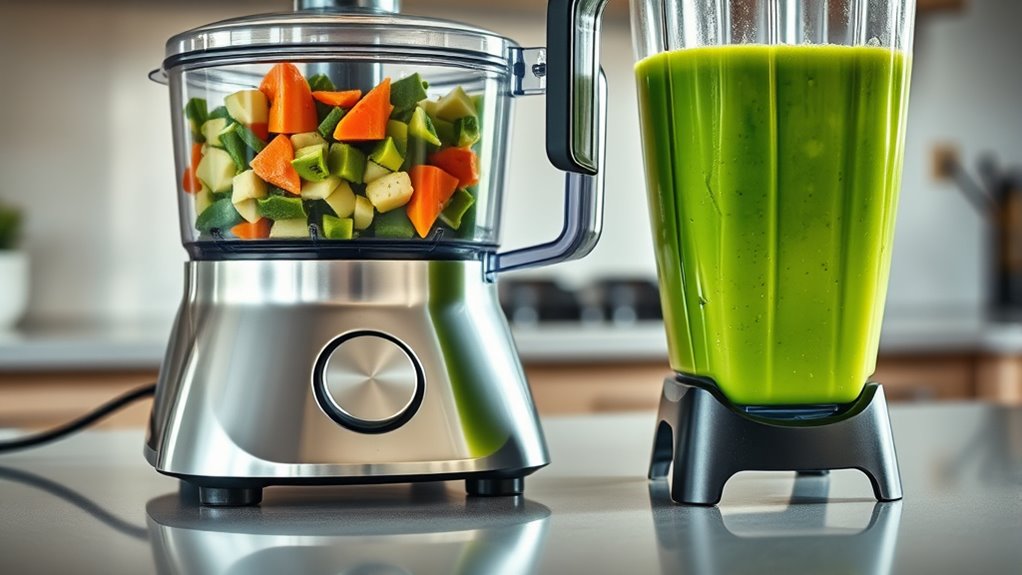
When deciding between a food processor and a blender, understanding their specific functions can help you choose the right appliance for your needs. Both are versatile in the kitchen, but they excel at different tasks. A blender is primarily designed for liquefying ingredients, making it ideal for smoothies, soups, and dairy alternatives like almond milk or cashew cream. If you want creamy textures or to blend up dairy-free milks, a blender’s powerful motor and sharp blades will give you smooth results. Many blenders also handle ice crushing with ease, turning frozen fruits or ice cubes into slushy drinks or chilled desserts. This makes them perfect for preparing cold beverages or textured smoothies that require breaking down ice into fine particles.
A food processor, on the other hand, is built for chopping, slicing, shredding, and kneading. It’s your go-to for preparing ingredients for cooking or baking, such as chopping vegetables, grinding nuts, or shredding cheese. While it can handle some dairy alternatives, like chopping nuts for dairy-free cheeses or mixing ingredients for vegan pâtés, it’s not optimized for creating smooth, liquid textures. Instead, it excels at creating coarse or uniform chunks, which is useful for recipes requiring a bit of texture. When it comes to ice crushing, a food processor generally isn’t the best choice. It might break down ice temporarily, but it will likely struggle with consistency and could stress the motor or blades, resulting in uneven textures or potential damage.
Choosing between the two depends on what you prioritize. If you often prepare smoothies, need to make dairy-free milk, or want to crush ice for frozen drinks, a blender is your best bet. Its ability to turn frozen ingredients into smooth, icy textures makes it invaluable for cold beverages. Conversely, if your focus is on meal prep, chopping vegetables, shredding cheese, or kneading dough, a food processor will serve you better. It’s designed for handling solids and bulkier ingredients rather than creating liquid or icy textures.
best blender for smoothies and ice crushing
As an affiliate, we earn on qualifying purchases.
As an affiliate, we earn on qualifying purchases.
Frequently Asked Questions
Can a Blender Replace a Food Processor for All Recipes?
A blender can’t replace a food processor for all recipes because it lacks the recipe versatility needed for tasks like chopping, slicing, or kneading. While a blender is efficient for smoothies and purees, it struggles with heavier or more precise prep work. You need both appliances to guarantee ideal appliance efficiency and to handle a wider range of recipes effectively. Relying solely on a blender limits your culinary options.
Which Appliance Is Better for Making Smoothies?
You should pick a blender for making smoothies — it’s your best bet for silky fruit smoothies and smooth vegetable blends. Ironically, while a food processor can handle some blending tasks, it often leaves your drinks chunkier. A blender’s powerful motor and sharp blades make quick work of fruits, ice, and veggies, giving you that perfectly smooth consistency every time. So, for smooth, delicious blends, go with a blender.
Is a Food Processor Suitable for Kneading Dough?
A food processor isn’t ideal for dough kneading because it doesn’t develop gluten as effectively as a stand mixer or by hand. While you can use it for small batches, it’s less consistent in kneading dough, which is vital for gluten development. For better results, opt for a stand mixer with a dough hook, ensuring proper gluten formation and a well-structured dough.
How Do Cleaning Requirements Differ Between the Two?
You’ll find that cleaning requirements differ mainly in cleaning techniques and residue removal. For a food processor, you need to disassemble parts and wash the blades carefully to remove sticky residues. With a blender, you can usually just fill it with warm water and soap, then blend briefly to loosen debris. Both require thorough rinsing, but food processors often demand more detailed cleaning to guarantee all residues are fully removed.
Are There Safety Concerns Unique to Either Device?
Did you know that about 20% of kitchen accidents involve blade injuries? When using either device, safety blade risks are a concern, especially if you mishandle blades during cleaning or operation. You should follow electrical safety precautions, like unplugging before cleaning and avoiding water contact with motor parts. Always handle blades carefully and keep fingers away from sharp edges to prevent cuts and electrical hazards.
food processor for chopping and shredding
As an affiliate, we earn on qualifying purchases.
As an affiliate, we earn on qualifying purchases.
Conclusion
Think of a food processor and a blender as your kitchen’s dynamic duo, each with its own superpower. A food processor chops like a skilled sculptor, while a blender smashes like a powerful hammer. Knowing which to use is like choosing the right tool for the job—it makes your cooking smoother and more enjoyable. So next time you’re in the kitchen, pick wisely and turn your culinary dreams into reality, just like a pro!
As an affiliate, we earn on qualifying purchases.
kitchen food processor with slicing and kneading
As an affiliate, we earn on qualifying purchases.
As an affiliate, we earn on qualifying purchases.
Columbus Day / Indigenous Peoples' Day Picks
long weekend sales
As an affiliate, we earn on qualifying purchases.